How to Choose Homeschool Curriculum Without Overwhelm
Feeling overwhelmed trying to choose a homeschool curriculum? That’s completely normal. The options can feel endless, and it’s easy to get lost scrolling through catalogs and websites, second-guessing every choice.
The secret is to stop looking out there for the perfect curriculum and start by looking inward—at your own family. The goal isn’t to find a flawless, one-size-fits-all program. It’s to build an educational path that feels authentic and genuinely works for your children.
Finding the Right Curriculum Starts with You

The sheer volume of choices is no illusion. The global homeschool curriculum market is massive—estimated at around USD 3.7 billion in 2024, with North America alone making up about USD 1.7 billion of that. You can dig into the numbers in this market report from Business Research Insights.
But that huge number doesn’t have to be intimidating. Instead, think of it as a vast buffet of resources waiting for you. The key is knowing how to filter out the noise, and that process starts with understanding your child, your teaching style, and your family’s core values.
The Four Pillars of Curriculum Selection
This guide is designed to give you a clear, actionable roadmap based on four foundational pillars. Focusing on these pillars will help you turn uncertainty into confidence by creating a filter that instantly narrows down the possibilities.
| Pillar | Key Action | Why It Matters |
|---|---|---|
| 1. Your 'Why' | Define your core educational values and create a detailed learner profile for each child. | This ensures the curriculum aligns with your family’s mission and your child’s unique needs. |
| 2. Your Options | Explore and understand major homeschooling styles—from Montessori to Charlotte Mason. | Finding a philosophy that resonates makes teaching more natural and learning more enjoyable. |
| 3. Your Test Drive | Trial curriculum choices using samples, reviews, and short-term commitments. | This prevents buyer’s remorse and confirms a good fit before you invest heavily. |
| 4. Your Plan | Map out your year, adapt schedules, and learn to manage record-keeping with ease. | A solid plan provides structure and freedom, turning good intentions into a successful year. |
By working through these pillars, you’ll be empowered to select materials that genuinely serve your family, rather than trying to fit your family into a pre-made box.
The most effective homeschool curriculum isn't something you find; it's something you build. It's a personalized framework that honors your child's curiosity, aligns with your family's values, and brings joy back into learning.
If you’re just getting started on this journey, our guide on https://themomresource.com/how-to-start-homeschooling/ provides a fantastic overview of those critical first steps.
The process is a journey, not a race. For families outside the US, resources dedicated to finding the best homeschool curriculum in the UK can offer valuable localized perspectives. Ultimately, our goal is to help you build an educational path that you and your children will truly love.
Create Your Family's Educational Blueprint
Before you even think about flipping through a curriculum catalog or getting lost in online reviews, the most important work happens right inside your own home. This is where you’ll create your family’s educational blueprint—the filter that will make every future decision simpler and clearer.
I know the temptation to jump straight to shopping is strong, but trust me on this: resisting that urge is the single best thing you can do to choose a curriculum with confidence.
Instead, let’s start by figuring out your family's unique vision for education. This isn't about writing some lofty, complicated mission statement. It’s about getting real about what truly matters to you.
Define Your Homeschooling Why
Your "why" is the anchor that will keep you steady on the hard days. It’s the real reason you chose this incredible, challenging path in the first place. When you have a strong sense of purpose, it’s so much easier to tell whether a curriculum genuinely aligns with your core goals or if it’s just a shiny distraction.
Grab a notebook and jot down the first things that come to mind for these questions. Don't overthink it.
- What do I want my children to love about learning? (Maybe it’s curiosity, the thrill of discovery, or the satisfaction of solving a tough problem.)
- What character traits do we want to build in our home? (Things like resilience, compassion, diligence, or a deep-rooted faith.)
- What did I love (or really dislike) about my own school experience?
- What does a successful homeschool day feel like? (Is it peaceful and focused? Energetic and loud? Structured or flexible?)
For our faith-based family, our answers helped us see that we wanted to view every subject through the lens of God's creation. For a Montessori-minded family, the answers might point toward fostering independence and hands-on discovery. Your answers are the pillars of your educational philosophy.
Your "why" isn't a destination; it's a compass. It ensures every choice—from curriculum to daily schedules—is pointing your family in the right direction.
Create a Detailed Learner Profile for Each Child
Once you have your family's big-picture vision, it's time to zoom in on the most important people in this whole process: your kids. A one-size-fits-all curriculum rarely works because our children are anything but one-size-fits-all. Taking a few minutes to create a "learner profile" for each child is an absolute game-changer.
This profile doesn’t need to be formal or complicated. Think of it as a simple snapshot of how your child is uniquely wired.
Key areas to consider for each child:
- Learning Style: How do they actually absorb information best? Are they a visual learner who needs to see charts and diagrams? An auditory learner who remembers everything they hear in a read-aloud? Or a kinesthetic learner who has to move, build, and touch things to truly get it?
- Current Passions: What are they obsessed with right now? Dinosaurs, coding, drawing comics, ancient Egypt? Leaning into their natural interests is one of the most powerful ways to ignite a genuine love for learning.
- Strengths & Weaknesses: Where do they fly with ease, and where do they need more patient support? Be honest here. Acknowledging a struggle with reading comprehension or math facts helps you find a curriculum that offers the right level of help, not just frustration.
- Energy & Attention: Does your child have boundless energy and need to run around every 20 minutes? Or can they happily sit and focus on a single task for an hour? This will massively influence the structure and pacing of whatever you choose.
A Real-World Scenario
Let’s imagine the "Smith" family. They have two kids: Liam, 9, is a classic kinesthetic learner who loves building things but gets frustrated by long worksheets. His younger sister, Clara, 6, is an auditory learner who could listen to stories all day long.
If Mrs. Smith chose a curriculum heavy on workbooks and seatwork, it would likely be a daily battle with Liam. It's a mismatch for his wiring.
But what if she chose a unit-study approach that involved building historical models, conducting hands-on science experiments, and listening to fantastic audiobooks? That could be a perfect fit for both kids, engaging their different styles. The family's blueprint helps them instantly filter out options that don’t support hands-on activities and rich read-alouds.
By the end of this process, you’ll have a clear, personalized blueprint. This simple document is your most valuable tool. As you start exploring the vast world of curriculum options, you won't be guessing anymore. You’ll be measuring each one against the only standard that truly matters: your family.
Navigate the World of Homeschooling Philosophies
Alright, with your family's educational blueprint in hand, you're ready to explore the exciting world of homeschooling approaches. Think of these philosophies less like rigid boxes and more like different languages of learning. The goal is to find the one that speaks most naturally to your family, making the whole process feel intuitive rather than overwhelming.
Instead of just memorizing definitions, let’s imagine how these methods actually feel in a real home on a typical Tuesday morning. Getting to the heart of each approach is the real key to finding your fit.
This decision tree visualizes how you can use that blueprint—your 'why,' your child's learning style, and their passions—to start sorting through the options.
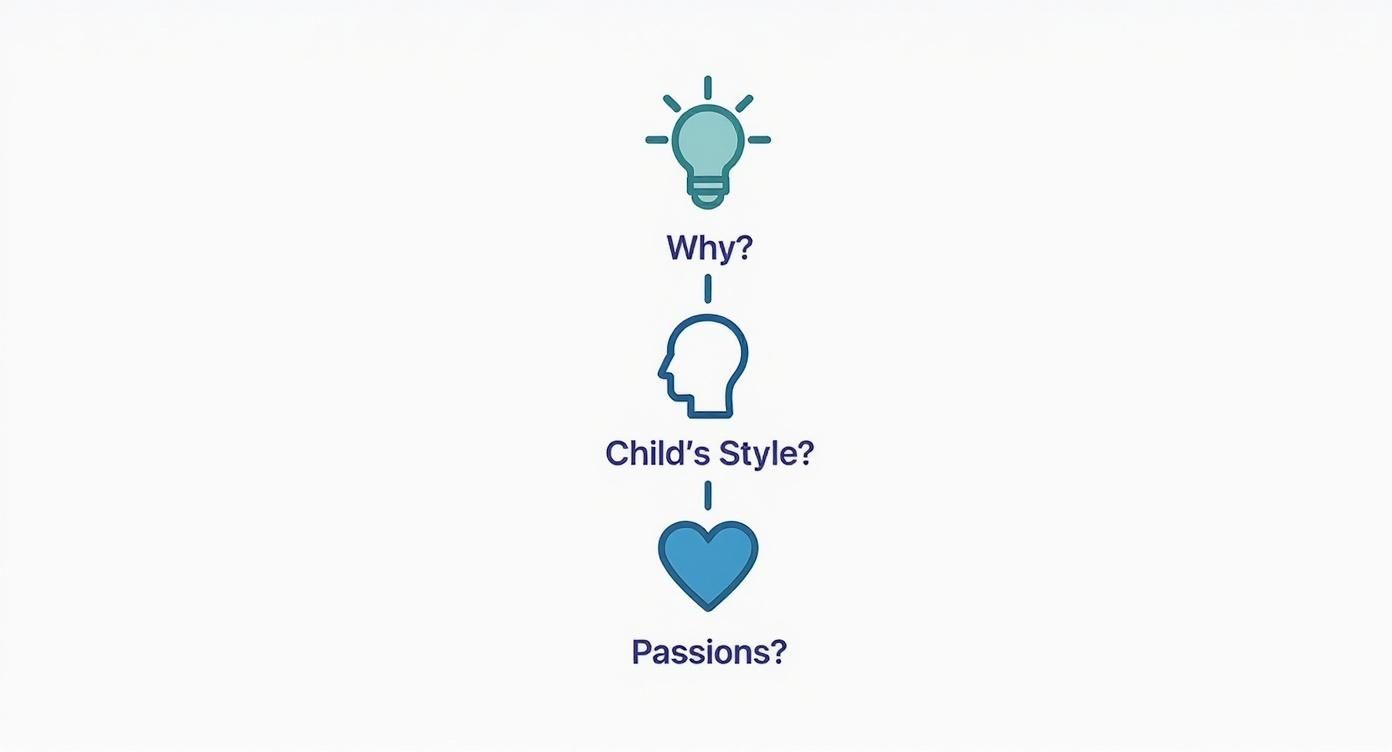
As you can see, your core values and your child's unique needs are the starting line, pointing you toward philosophies that just make sense for your family's goals.
Exploring the Core Homeschooling Models
Let's demystify some of the most common approaches you'll come across. Each one offers a unique rhythm and focus, naturally attracting different kinds of families and learners.
Here’s a quick look at the big players. This table breaks down the core ideas behind each method, who it might work for, and what it asks of you as the parent-teacher.
Comparing Popular Homeschooling Philosophies
| Philosophy | Core Principle | Best For Learners Who… | Parent Involvement |
|---|---|---|---|
| Classical | Learning follows a three-part "Trivium" (Grammar, Logic, Rhetoric). | Thrive on structure, enjoy language and history, and are strong analytical thinkers. | High; parent acts as a guide through a rigorous, content-rich curriculum. |
| Charlotte Mason | Education is an atmosphere, a discipline, a life; emphasizes living books and nature. | Are curious, love stories, and do well with short, focused lessons and hands-on nature exploration. | High; parent curates a rich learning environment and facilitates learning through discussion. |
| Montessori | The child leads their own learning within a carefully prepared, hands-on environment. | Are independent, self-motivated, and benefit from kinesthetic and sensory learning materials. | Medium; parent prepares the environment and observes, guiding rather than directly instructing. |
| Eclectic | Mix and match the best resources from various philosophies to suit the child. | Have unique learning styles or when siblings have very different needs. | Varies; parent acts as a curriculum designer, requiring research and planning. |
Each philosophy offers something beautiful. It’s not about which one is "best," but which one feels most like home for your family.
Choosing a philosophy isn't about finding the 'best' one—it's about finding the one that best reflects your family's personality, values, and vision for learning.
Let's unpack these a bit more:
-
Classical Education: This is a highly structured, language-focused method that follows a three-part pattern: the Grammar stage (memorizing facts), the Logic stage (analyzing relationships), and the Rhetoric stage (expressing conclusions). It’s rigorous, with a strong emphasis on history, Latin, and logical thinking.
-
Charlotte Mason: This is my personal sweet spot. It's a gentle, literature-rich approach built on the idea that children are whole persons who deserve a wide feast of ideas. It emphasizes "living books" over dry textbooks, nature study, art appreciation, and short lessons to build habits of attention.
-
Montessori: Developed by Maria Montessori, this child-led philosophy centers on a prepared environment with specific hands-on, self-correcting materials. The goal is to foster independence and a natural love for learning by letting the child choose their work. If you're comparing it to another gentle approach, our guide on Charlotte Mason vs. Maria Montessori learning methods offers a great side-by-side look.
-
Eclectic or Relaxed: This is the ultimate mix-and-match approach and is incredibly popular. An eclectic family might use a structured math program, a hands-on science kit, and a literature-based history curriculum, picking the "best of the best" for each subject.
From Philosophy to Practical Format
Beyond the big ideas, curriculum also comes in different packages. The format you choose will directly shape your day-to-day planning and how much you have to teach.
Common Curriculum Formats:
- All-in-One Boxed Sets: These kits provide everything you need for a grade level, from teacher’s manuals to workbooks. They are fantastic for new homeschoolers who crave structure and want to ensure there are no gaps.
- Online or Virtual Programs: These offer digital lessons, automated grading, and sometimes even live classes. The homeschooling market has seen a huge shift toward these tech-driven solutions as companies invest heavily in e-learning.
- Unit Studies: I love these for families with kids of different ages. Learning is centered around a single topic (like Ancient Egypt), and all subjects—history, science, art—are integrated into that theme. Everyone can learn together at their own level.
- Literature-Based: Similar to unit studies, this format uses excellent books as the spine for learning. History is learned through historical fiction, science through biographies of scientists, and so on.
Aligning Philosophy with Your Family Blueprint
Now, let's bring it all back to that blueprint you created. This is where the magic happens.
Imagine a family whose blueprint prioritizes hands-on learning, independence, and a calm, orderly home. They would naturally gravitate toward a Montessori approach. A family that values deep theological discussions, classic literature, and a love for nature would find a beautiful fit with Charlotte Mason.
On the other hand, a family with a highly logical, STEM-minded child who thrives on structure might find the Classical model to be a perfect match. And the family with three kids who have completely different learning styles? They will likely find freedom and success by taking an Eclectic approach.
Your blueprint isn’t just a document; it’s your compass. It lets you walk into the vast library of homeschool curriculum, confidently bypass the sections that don't fit your vision, and head straight for the shelves that hold the resources meant to bring your family's educational journey to life.
How to Test Drive Your Curriculum Choices

You’ve mapped out your family’s educational vision and explored different homeschool philosophies. Now for the fun part: moving from theory to practice to see how your top curriculum contenders actually feel in your home. This test-drive phase is your secret weapon against buyer’s remorse.
Thankfully, most curriculum publishers get it. They understand you need to see their materials in action, so they often provide generous samples, free trials, or even money-back guarantees. This gives you a chance to get a genuine feel for their approach before making a big financial commitment.
Think of this process less like a final exam and more like trying on shoes. You need to walk around a bit to see if they pinch, if they offer the right support, and if they feel right for the long journey ahead. A curriculum can look perfect online but feel clunky and unnatural in your daily rhythm.
Find and Use Curriculum Samples
Your first task is to become a sample detective. Go to the websites of your top choices—nearly every major publisher offers sample lessons, usually as a downloadable PDF. Don't just glance at them. Print them out and actually use them.
When you’re looking at the samples, keep an eye on a few key things:
- Teacher’s Guide: Is it easy to follow? Does it give you clear, simple instructions, or does it feel confusing and require hours of prep just for one lesson?
- Student Materials: Are the pages cluttered and overwhelming, or are they clean and engaging? Do the activities seem like a good fit for your child's learning style?
- Pacing and Tone: Does the lesson feel rushed, or does it have a more gentle, flexible pace? Does the language resonate with your family’s values?
For example, a sample from a Charlotte Mason-inspired curriculum will likely feature a beautiful living story with narration prompts. A sample from a Classical program, on the other hand, might focus on memory work and structured charts. See which one makes you feel more excited to teach.
The Power of a Low-Pressure Test Week
Once you have samples from your top two or three choices, schedule a "test week." The key here is low-pressure. This isn't about getting a full week of schoolwork done; it's about gathering real-world data on what clicks with your family.
Try a math lesson from Curriculum A on Monday and one from Curriculum B on Tuesday. Do a history lesson from your first choice on Wednesday. The goal is simply to observe, not to master the content.
A curriculum isn't just a set of books; it's a tool that shapes your daily interactions and the atmosphere of your home. A test week helps you see which tool feels most natural in your hands.
During this week, pay close attention to the reactions—both yours and your child's. Did your hands-on learner light up at the science experiment? Did your auditory learner snuggle in close during the read-aloud portion? As the teacher, did you feel confident and prepared, or stressed and overwhelmed? These small observations are incredibly valuable.
Use a Scorecard for Objective Decisions
Feelings are important, but it’s also helpful to have an objective way to compare your options. This is where a simple "Curriculum Scorecard" comes in handy. Just create a basic chart where you can rate each curriculum against the core elements of your family's educational vision.
Your scorecard might include categories like:
- Alignment with 'Why': How well does it support our core values (e.g., faith integration, fostering independence)?
- Child Engagement: How interested and involved was my child?
- Parent-Friendliness: How easy was this for me to prepare and teach?
- Learning Style Fit: Does it suit my child's visual, auditory, or kinesthetic needs?
- Schedule Flexibility: Can I easily adapt this to our family’s rhythm?
Rate each category on a simple scale of 1 to 5. When you’re done, you’ll have a clear, visual comparison that goes beyond just a gut feeling. I've found that this simple exercise often makes the final decision feel obvious and peaceful.
By testing your choices this way, you’re not just guessing. You’re making an informed, confident decision based on real-world evidence from your own home.
Customize Your Curriculum for Faith or Montessori
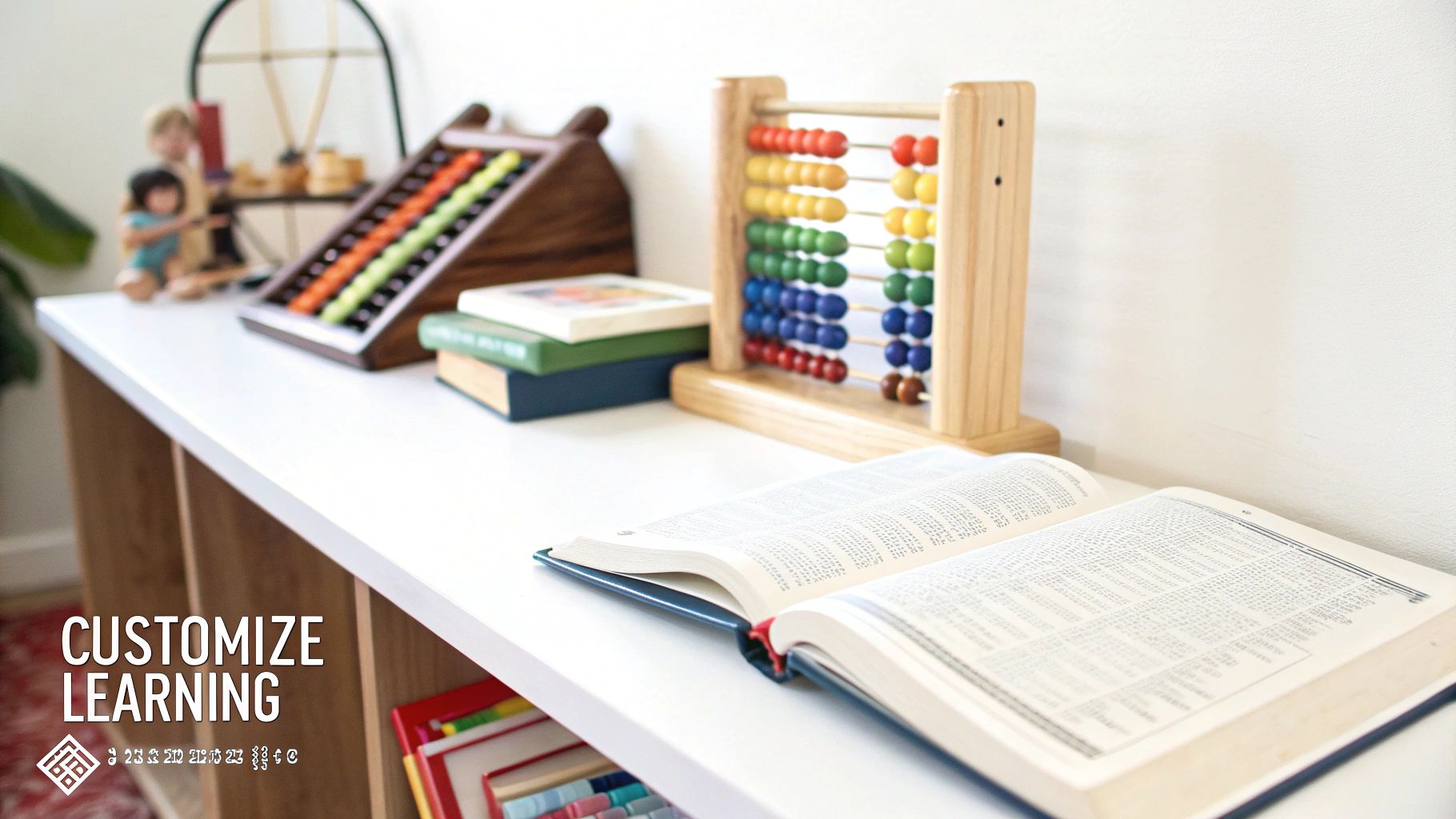
Your curriculum should be a tool that reflects your family's deepest values, not something that forces you to compromise them. For many of us, this is the very reason we chose to homeschool in the first place—to create a learning environment that aligns with our specific beliefs and educational philosophies.
This is especially true for faith-based and Montessori-minded families. The good news is, you don’t have to pick between academic rigor and your core principles. In fact, weaving your values into your homeschool can make learning richer and far more meaningful for your kids.
This desire for value-aligned education is a huge reason why homeschooling has grown so much. The number of homeschooled children in the U.S. jumped from around 2.3 million in 2016 to 3.7 million by 2021. That's a massive shift, and it shows that parents are actively seeking educational paths that truly fit their family's needs and beliefs.
Weaving Faith into Every Subject
For many Christian families, the goal isn't just to tack a Bible class onto the schedule. It's about seeing every single subject through the lens of a biblical worldview. This doesn't mean you're limited to curricula explicitly labeled "Christian," either. You can absolutely adapt excellent secular resources to fit your goals.
For instance, when studying biology, you can pair a standard textbook with conversations about the complexity and wonder of God's creation. A history lesson on the Roman Empire suddenly becomes a powerful opportunity to discuss the perseverance of the early church.
Here are a few practical ways I've seen this work beautifully:
- Use Living Books: Alongside your main history spine, choose biographies of missionaries or historical fiction that highlights Christian virtues in action.
- Add Discussion Prompts: When reading literature, just ask simple questions like, "How did this character show grace?" or "What does this story teach us about redemption?"
- Connect Science to Awe: During a nature walk, pause to really appreciate the design in a flower or the physics of a flowing stream, framing it as a study of the Creator's handiwork.
Of course, starting with a program designed with this in mind can make life a whole lot easier. If you're looking for great options that won't break the bank, our guide to https://themomresource.com/affordable-christian-homeschool-curriculum/ is the perfect place to start your search.
Adapting for a Montessori Approach
If your family is drawn to the Montessori philosophy, you already value independence, hands-on learning, and a thoughtfully prepared environment. The wonderful thing is that you can bring this spirit to almost any curriculum with a few intentional shifts.
Even if you use a more traditional workbook for math, you can supplement it with Montessori-style manipulatives like bead chains or number rods. This gives your child a concrete way to understand abstract concepts, honoring that crucial hands-on path to learning.
The essence of Montessori at home isn't about owning every specific material; it's about fostering an environment of respect, independence, and child-led discovery.
To help create this atmosphere:
- Organize for Independence: Store materials on low, accessible shelves so your child can select and put away their own work. This small change makes a huge difference.
- Break Down Lessons: Present concepts in small, manageable steps. Then, step back and allow your child to work at their own pace without interruption.
- Incorporate Practical Life Skills: Cooking, gardening, and caring for the home are central to Montessori education. Weave them right into your daily rhythm as valuable learning experiences.
When you're leaning into a Montessori approach, knowing which materials to introduce and when is key. You can find some fantastic ideas for Montessori toys by age that support this hands-on philosophy. Ultimately, customizing your curriculum is all about making it truly your own—a tool that serves your family’s unique vision for education.
Answering Your Big Homeschool Curriculum Questions
As you get closer to a decision, a few practical questions almost always start to bubble up. It's totally normal to have those nagging worries about the budget, making the "wrong" choice, or figuring out the legal side of things. Let's tackle these common concerns head-on so you can move forward with confidence.
Think of this as the final check-in before you click "buy." Getting these last few things sorted out will bring a whole lot of peace to your decision.
How Much Should I Expect to Spend on Curriculum?
This is the big one, isn't it? The good news is the answer is incredibly flexible: you can spend anywhere from next to nothing to several thousand dollars per child. A dedicated family using the library, free online resources, and printable worksheets can absolutely craft a rich education for pennies.
Most families I know find a comfortable middle ground, landing somewhere between $300-$700 per child for the year. This range allows for a solid mix of quality workbooks, a few digital subscriptions, and core resources without feeling like you're breaking the bank.
Of course, there are other options on the higher end:
- All-in-one boxed sets can run anywhere from $500 to over $2,000. The appeal here is convenience—every single subject is planned out for you, ready to go.
- Online schools with live teacher support are the biggest investment, with costs that often look more like private school tuition.
My best advice? Don't let the budget lead the way. First, figure out how you want to teach, then find resources within that style that fit your budget. The right fit is always more important than the price tag.
What If I Pick the Wrong Curriculum?
I think this is the number one fear for nearly every new homeschooling parent, so let's reframe it. One of the greatest gifts of homeschooling is its incredible adaptability. No curriculum choice is permanent. If a program is causing daily tears (for you or your child!), it's not a failure to stop using it. It's a smart, responsive adjustment.
Think of a mismatched curriculum not as a mistake, but as valuable data. You just learned, firsthand, what doesn't work for your family, which gets you one giant step closer to what does.
Give any new program a fair shot—I usually recommend six to eight weeks to get past the initial learning curve. But if you know in your gut it's a bad fit, you have full permission to set it aside. I've switched programs mid-year, and so have many seasoned homeschoolers I know. This flexibility is a gift—use it!
How Do I Make Sure My Curriculum Meets State Requirements?
This is a non-negotiable step that should happen early in your planning. Your first stop should be the Home School Legal Defense Association (HSLDA) website. They do a fantastic job of breaking down the homeschool laws for every state in a way that's easy to understand.
For the official word, always double-check your state's Department of Education website. You’ll need to know:
- Which subjects are mandatory for your child's grade level.
- What kind of records you need to keep (like attendance or a portfolio of work).
- If standardized testing is required at certain grade levels.
When you're looking at different curricula, most major publishers are very clear about which core subjects their materials cover. Making sure you're compliant from day one removes a massive amount of stress and lets you focus on the actual joy of learning.
Can I Mix and Match Different Programs?
Absolutely! In fact, this "eclectic" approach is one of the most popular methods out there, and for good reason. It puts you in the driver's seat as the true expert on your child.
You might fall in love with a hands-on math program from one company that finally makes numbers click for your kid, but find their literature selections feel a little dry. Go for it! Pair that amazing math curriculum with a beautiful, story-based history program from another publisher and a science kit from a third.
This strategy lets you pick the "best-in-class" resource for each subject instead of being locked into a single system that might be strong in one area but weak in another. It's the ultimate way to customize an education that fits your child like a glove.
At The Mom Resource, we believe in equipping you with the confidence and tools to build a learning environment that reflects your family’s unique heart and vision. Explore more resources and join our community at https://themomresource.com.