Choosing a Christian Homeschool Curriculum
Choosing a Christian homeschool curriculum is one of the biggest decisions you'll make. It goes so much deeper than just picking out a few textbooks or workbooks; you're intentionally shaping your child's heart and mind through a biblical worldview.
There's no single "best" curriculum that works for everyone. The best one is the one that truly clicks with your family's spiritual goals, your own unique teaching style, and how your child learns best. My goal with this guide is to walk you from that feeling of uncertainty to a place of confidence, helping you make a choice that honors God and helps your child flourish.
Starting Your Faith-Based Homeschool Journey
Stepping into home education is an incredible privilege, but let's be honest, it's also a huge responsibility. You're not just teaching subjects; you are cultivating a soul. You're building character and laying down a spiritual foundation that will support them for the rest of their lives.
This journey is really an act of discipleship, where every single lesson—whether it's math, science, or grammar—becomes another opportunity to point your children back to their Creator.
Choosing this path puts you in good company. Homeschooling has grown tremendously, with around 3.1 million K-12 students being homeschooled during the 2021-2022 school year. This boom has led to a wonderful variety of Christian homeschool curriculum options as more families seek to weave their faith into every aspect of their children's education.
Why Your Approach Matters
Think of your curriculum as the blueprint for your child's educational home. Is faith going to be just one room in the house, a room you visit once a day for Bible class? Or is it the very foundation everything else is built on—the concrete slab that supports math, science, literature, and history?
A truly integrated Christian homeschool curriculum always aims for the second option. It’s about weaving a biblical worldview into the very fabric of every subject.
- In science, it’s about celebrating God as the master designer of an orderly and awe-inspiring universe.
- In history, it’s about revealing His sovereign hand guiding the course of nations and people.
- In literature, it’s about exploring deep themes of redemption, truth, and human nature through a scriptural lens.
This holistic approach means learning is never walled off from faith. It connects academic knowledge to spiritual truth, helping our kids see the world through God’s eyes and understand their unique place in His grand story.
This guide will help you sort through all these important ideas. We'll unpack the different philosophies, from the gentle, nature-based approach of Charlotte Mason to the structured Classical model. We’ll give you the tools to find a curriculum that feels like a natural extension of your family’s mission, because this process of biblical parenting and nurturing your child's faith is at the heart of it all.
Defining a Truly Christian Curriculum
What really makes a homeschool curriculum Christian? It’s a question that goes so much deeper than just slapping a Bible verse on a science lesson or tacking on a daily devotional. Honestly, it points to a fundamental difference in how we see education itself, and it’s one of the first big things you’ll need to think through for your family.
Imagine you're building a house. One way to do it is to build the whole structure—walls, rooms, roof—and then hang some beautiful Christian art on the walls. The art is meaningful, for sure, but it isn't part of the house's foundation. This is what it looks like when a curriculum treats the Bible as just another subject, kept separate from math, history, and language arts.
But there's another way. You can build that same house on a solid, unshakeable foundation of faith. In this model, every single beam, every window, and every doorway is placed with that foundation in mind. This is exactly what a truly integrated Christian homeschool curriculum sets out to do—it weaves a biblical worldview through every single discipline, from literature clear through to mathematics.
More Than Just an Add-On
In a worldview-integrated curriculum, faith isn't an accessory; it's the very lens through which your child views and understands everything they learn. This distinction changes everything. It shapes how subjects are taught and what gets emphasized, making sure that God isn't boxed into a 30-minute Bible lesson but is seen as the author of all truth.
When you take this approach, your subjects start to look different:
- Mathematics becomes a study of God’s incredible order, precision, and consistency, all of which reflect His unchanging character.
- Science turns into an exploration of His magnificent creation, sparking a sense of awe and worship for the Creator.
- History is no longer a random list of dates and events but the unfolding of God’s redemptive plan for humanity—it’s truly His story.
- Literature becomes a powerful tool for examining the human condition, morality, and virtue through a scriptural framework.
Many families find that using literature rich in Christian allegory is a wonderful way to do this. For example, exploring the timeless themes in The Chronicles of Narnia series helps children wrestle with profound spiritual truths in a way that feels natural and engaging.
Key Questions for Evaluating Faith Integration
To figure out how deeply a curriculum integrates faith, you have to become a bit of a detective. Don’t just take the marketing claims at face value; get your hands on actual lesson samples and teacher’s guides and dig in.
A curriculum's real worldview shines through not in its statement of faith, but in how it handles the difficult questions and nuanced topics within each subject. That’s where you see if faith is the foundation or just a decoration.
As you look over different programs, ask yourself these critical questions:
- How is the Bible used? Is it just a source for memory verses, or is Scripture treated as the primary source for understanding truth in history, science, and ethics?
- What is the view of history? Does the curriculum present history as a series of random, disconnected events, or does it consistently point to God's sovereignty and providential hand at work?
- How are science and origins taught? Does the material present a biblical view of creation as a valid and foundational framework for scientific study?
- How is literature analyzed? Are stories and characters evaluated based on biblical virtues and the timeless principles of truth, goodness, and beauty?
At the end of the day, choosing a curriculum is a spiritual decision. By asking these kinds of questions, you can see past the surface-level labels and find a Christian homeschool curriculum that truly aligns with your family’s deepest convictions and helps you disciple your children with confidence.
Exploring Popular Christian Homeschooling Methods
Once you've wrapped your head around the idea that a truly Christian curriculum is built on a biblical worldview, the next step is figuring out how to bring that vision to life. This is where you get to explore all the different educational philosophies.
Think of these methods not as rigid boxes, but as different paths up the same mountain. Each one offers a unique and beautiful journey toward the same goal: raising children who love God and love learning. Finding the right fit is all about discovering what resonates with your family’s personality, your teaching style, and your child's natural way of learning.
Let's walk through some of the most beloved approaches in Christian homeschooling to help you find that perfect fit for your family.
The infographic below really nails the two core ways curricula integrate faith. One way treats the Bible as just another subject, while the other weaves a biblical worldview into the very foundation of all learning.
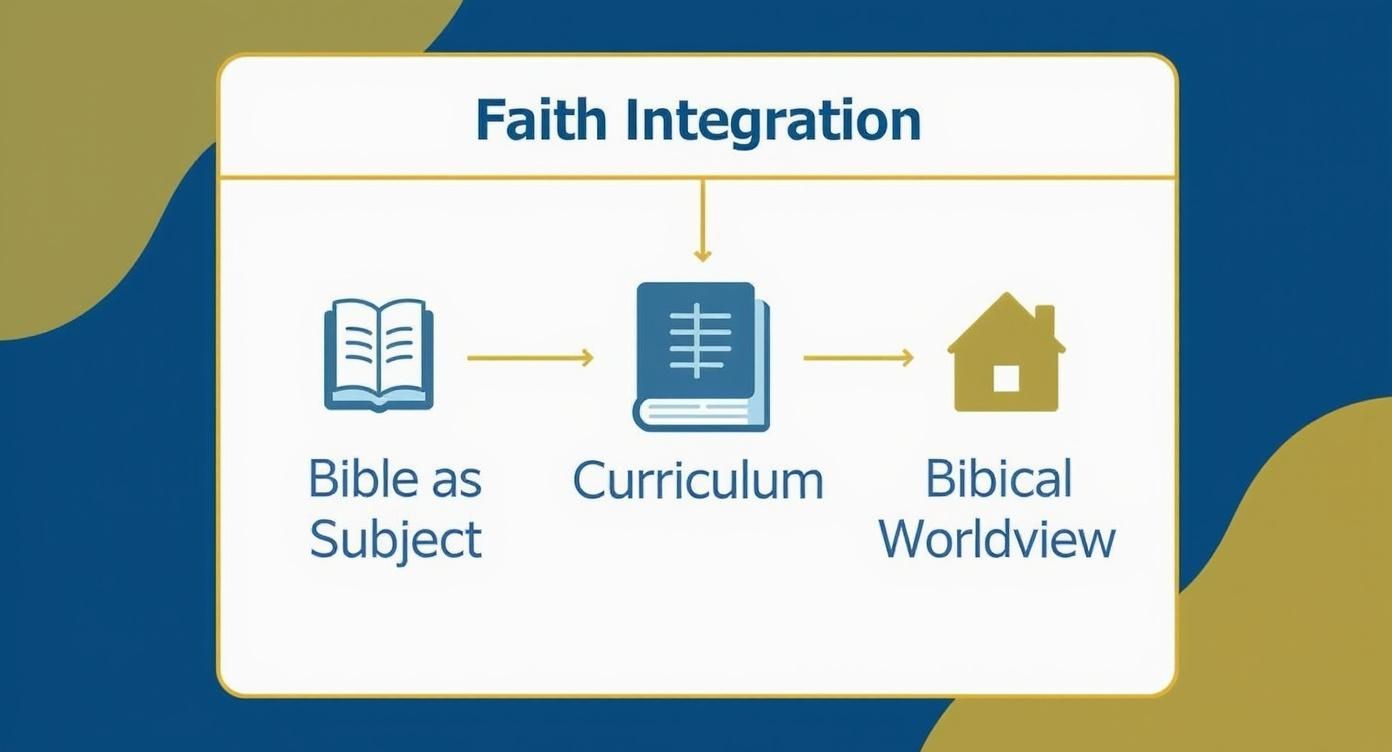
This visual highlights that critical difference between simply adding faith to academics versus starting with faith as the source of all knowledge.
The Charlotte Mason Method
The Charlotte Mason approach is a gentle, relational method built on the beautiful idea that children are whole persons, created in God's image. This philosophy ditches dry textbooks and rote memorization, focusing instead on what she called a "living education." It's an education filled with beautifully written books, firsthand encounters with nature, and a deep appreciation for art and music.
A day in a Charlotte Mason homeschool is rich and varied but also surprisingly short. Lessons are kept brief to hold a child’s full attention, and they're often followed by narration—where the child simply tells back in their own words what they just learned. This simple act builds powerful skills in comprehension, sequencing, and communication.
- Core Elements: Living books, narration, nature study, short lessons, and art/music appreciation.
- Faith Integration: Faith is woven throughout everything. Children study the Bible directly, learn hymns, and are guided to see God’s handiwork in nature, art, and history. The focus is on building a personal, living relationship with the Creator.
- Best For: Families who value a gentle, literature-rich education and want to cultivate a lifelong sense of wonder in their children. If this sounds like you, you might be interested in our deep dive into the Charlotte Mason homeschool method.
The Classical Method
The Classical method is a rigorous, language-focused approach that follows a developmental pattern called the Trivium. This model is brilliant because it aligns the learning stages with a child's natural cognitive development, moving from concrete knowledge to abstract thinking and, finally, to articulate expression.
Think of it like building a house: first, you lay a solid foundation of facts (Grammar), then you erect the structural framework of logic (Logic), and finally, you finish it with the beautiful, persuasive details of rhetoric (Rhetoric).
The Classical model’s goal is not just to teach subjects, but to forge a thinking, discerning, and articulate Christian mind capable of defending the faith and shaping culture.
The stages of the Trivium are:
- Grammar Stage (Grades K-4): Little kids are sponges for information. This stage is all about memorizing the foundational facts—math facts, historical timelines, scientific classifications, and Latin roots—often through catchy songs and chants.
- Logic Stage (Grades 5-8): As children naturally start to question and analyze, this stage teaches them formal logic and critical thinking. They learn to connect the facts, identify fallacies, and build sound arguments.
- Rhetoric Stage (Grades 9-12): Teenagers have a natural desire to express themselves. This final stage capitalizes on that by teaching them to communicate their ideas winsomely and persuasively through writing and public speaking.
Unit Studies And The Eclectic Approach
For families who crave flexibility, the Unit Study and Eclectic methods offer wonderful freedom. A Unit Study approach centers all learning around a single topic—like Ancient Egypt, the ocean, or the Reformation—and connects every subject back to that central theme. For example, while studying the ocean, you might read Moby Dick (literature), calculate whale migration distances (math), and study marine ecosystems (science). It’s a fantastic way to show how knowledge is interconnected.
The Eclectic approach is the ultimate mix-and-match style. You might love the math curriculum from one publisher, the history from another, and a literature-based science program from a third. This allows parents to handpick the absolute best curriculum for each subject, perfectly suiting their child’s individual needs.
As part of a rich, eclectic approach, many families find it helpful to learn How To Read The Bible For All It's Worth to help their students engage deeply with scripture.
Many families find their perfect fit with well-known publishers that cater to these styles. For example, The Good and the Beautiful is currently the most-searched Christian homeschool curriculum company globally. Following it are other prominent providers like Classical Conversations, which has championed its structured, community-based classical model since 1997, and Master Books, which serves K-12 families with a strong focus on apologetics and creation science.
How to Choose the Right Curriculum for Your Family
Navigating the world of Christian homeschool curriculum can feel like standing at a crossroads with a dozen different paths stretching out before you. It's so easy to get overwhelmed. But I want to let you in on a little secret: the goal isn't to find a "perfect" curriculum—because one doesn't exist.
The real goal is to prayerfully and intentionally choose the one that best serves your unique family. This process is less about checklists and more about discipleship. When you turn this decision over to God and thoughtfully consider a few key areas, you can transform what feels like a monumental task into a manageable and even joyful journey. This isn't just an academic choice; it's a spiritual one that will shape the heart and atmosphere of your home.
Start with Your Family's Foundation
Before you even glance at a single curriculum catalog, the most important step is to look inward and upward. Your family's core beliefs and mission should be the compass that guides every other decision you make. A curriculum is just a tool, after all. You need to know what you're building before you can choose the right one.
Start by discussing and writing down your family's educational mission statement. This doesn't have to be complicated! It can be as simple as, "Our goal is to raise children who love the Lord, seek truth, and use their gifts for His glory."
With that foundation in place, you can ask more specific, targeted questions:
- Doctrinal Alignment: Does this curriculum honor Scripture as the ultimate authority? How does it handle topics like creation, world history, and moral issues?
- Worldview Integration: Does it simply tack on a Bible lesson, or does it genuinely weave a biblical worldview through every single subject?
- Character Goals: What virtues and character qualities do we want to cultivate in our children? Does this curriculum support that mission?
Evaluate Your Teaching Style
The most beautifully designed curriculum will only collect dust if it doesn't mesh with your personality as a teacher. Are you someone who thrives on a detailed, open-and-go lesson plan? Or do you prefer the freedom to follow rabbit trails and adapt on the fly? Being honest about your own strengths and weaknesses is absolutely crucial.
Choosing a curriculum is like choosing a dance partner. A good fit makes the experience graceful and enjoyable; a poor fit leads to frustration and stepping on each other's toes. Match the curriculum's rhythm to your own.
Consider which of these descriptions sounds most like you:
- The Planner: You love checklists, clear schedules, and knowing exactly what you need to do each day. A structured, all-in-one boxed curriculum might just be your best friend.
- The Explorer: You're energized by new ideas and love the freedom of creating your own lessons. An eclectic approach or a literature-based unit study would give you the flexibility you crave.
- The Mentor: You see teaching primarily as a conversation and an act of discipleship. A Socratic or Charlotte Mason approach that emphasizes discussion and narration could be a wonderful fit.
Understand Your Child's Learning Preferences
Just as important as your teaching style is your child’s unique, God-given way of learning. Paying attention to how your child naturally engages with the world will help you choose a Christian homeschool curriculum that sparks their curiosity rather than stifling it. While every child is a unique blend, you can often spot general patterns.
Is your child a:
- Kinesthetic Learner? They learn best by doing, moving, and touching. Look for curricula packed with hands-on projects, experiments, and activities.
- Auditory Learner? They retain information best by hearing it. A curriculum that uses songs, audiobooks, and rich discussion will be incredibly effective for them.
- Visual Learner? They need to see information to really grasp it. Seek out programs with beautiful illustrations, helpful charts, videos, and well-designed workbooks.
Once you have clarity on these core areas—your family's mission, your teaching style, and your child's learning needs—you're ready to start exploring specific options. Review curriculum samples online, read reviews from like-minded families, and most importantly, pray for wisdom. Trust that God will guide you to the resources He wants you to use in this beautiful calling of home education.
A Spotlight on Christian History and Science

While a biblical worldview touches every subject, its impact is most profound and visible in history and science. These are the two areas where a faith-based education often diverges most sharply from what’s taught in a traditional classroom.
In a typical school setting, history can feel like a jumble of disconnected dates and events. Science is often presented through a lens that has no room for a Creator. A Christian homeschool curriculum flips that script entirely, weaving these subjects into the grand tapestry of God’s story.
Teaching History as His Story
Christian homeschool history has come a long way. Programs like Mystery of History and Notgrass History have become favorites for how beautifully they integrate a biblical worldview. They teach what’s often called ‘providential history’—a way of looking at the past that sees God’s hand at work through all of it. The best of these curricula are known for their strong biblical connections, character-building stories, and moral reflections that you just won't find in a purely secular account. You can find more insights on the best approaches to homeschool history at Wild World of History.
This approach transforms history from a boring academic chore into a faith-building journey through God’s faithfulness.
Providential history doesn't just ask, "What happened?" It pushes our kids to ask a much deeper question: "What was God doing?" This helps them see history not as a string of accidents, but as the purposeful unfolding of God’s redemptive plan for His people.
For instance, a curriculum like The Mystery of History masterfully weaves biblical events and world history into a single, cohesive timeline. Your kids don't learn about ancient Egypt in one book and the life of Moses in another—they learn about them together, seeing exactly how sacred and secular history intersect. This integrated method gives them the big picture of God's work across all nations and through all ages.
It’s a powerful framework for understanding their own place in the world. It builds a sense of purpose and security, showing our children that the same God who guided empires and parted seas is intimately involved in their lives today.
A Scientific Lens of Awe and Worship
In the same way, science education in a Christian homeschool curriculum is built on a completely different foundation. Where secular science often starts with the assumption of naturalism (the idea that nature is all there is), faith-based science begins with God as the Creator.
This one foundational difference changes everything. Publishers like Master Books and Answers in Genesis design their science materials to reveal the intelligence, power, and glory of God in creation.
Here’s how that plays out in practice:
- Biology: Instead of focusing only on evolution as the engine of life, lessons explore the mind-boggling design of ecosystems and the irreducible complexity of a single cell, all pointing to an intelligent Designer.
- Astronomy: Studying the cosmos becomes an act of worship. We explore the sheer vastness and order of the universe as a powerful testament to God's majesty.
- Geology: We look at Earth's history, including things like the fossil record, through the framework of a biblical timeline that includes a global flood.
This approach does more than just present an alternative scientific model; it aims to cultivate a heart of worship. By studying the natural world through a biblical lens, our children learn to see God’s fingerprints everywhere. Science becomes a tool not just for understanding the world, but for knowing and glorifying the One who made it all.
Bringing Your Homeschool Vision to Life
You’ve chosen your curriculum, you’ve prayed through your vision, and now it’s time to step into the beautiful, messy, rewarding reality of day-to-day homeschooling. This is where all that planning finally meets practice—where you get to transform stacks of books and hopeful schedules into living, breathing days filled with learning and discipleship.
Just remember, your first year is a journey of discovery for everyone. The ultimate goal isn't to execute a flawless plan but to faithfully nurture the hearts and minds God has entrusted to you. Grace will be your most essential supply. Some days will flow beautifully, filled with wonder and connection. Others might feel like a lesson in patience and perseverance for you more than for your kids. Both are valuable.
Embrace the freedom that homeschooling offers! If a lesson isn’t clicking, give yourself permission to set it aside and try again tomorrow. If the sun is shining and a nature walk is calling your name, go answer it. Flexibility isn’t a sign of failure; it’s the hallmark of a healthy, Christ-centered home where relationships are always prioritized over rigid checklists.
Organizing Your Space and Spirit
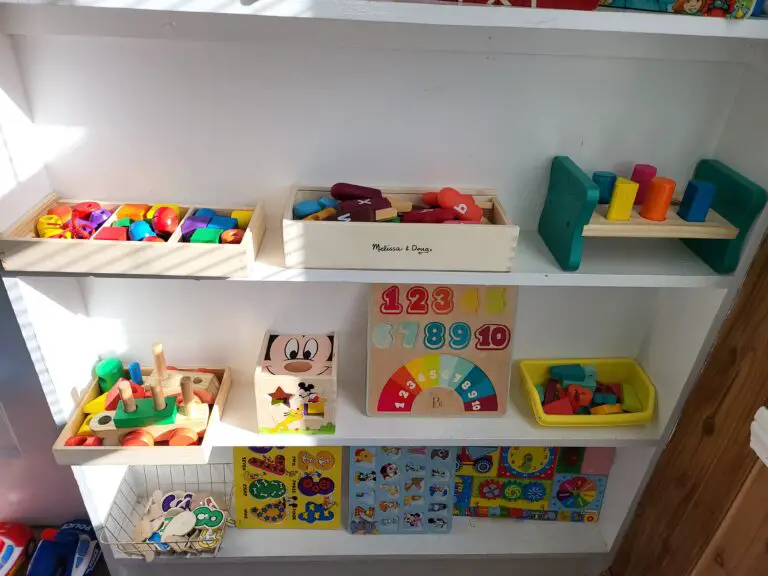
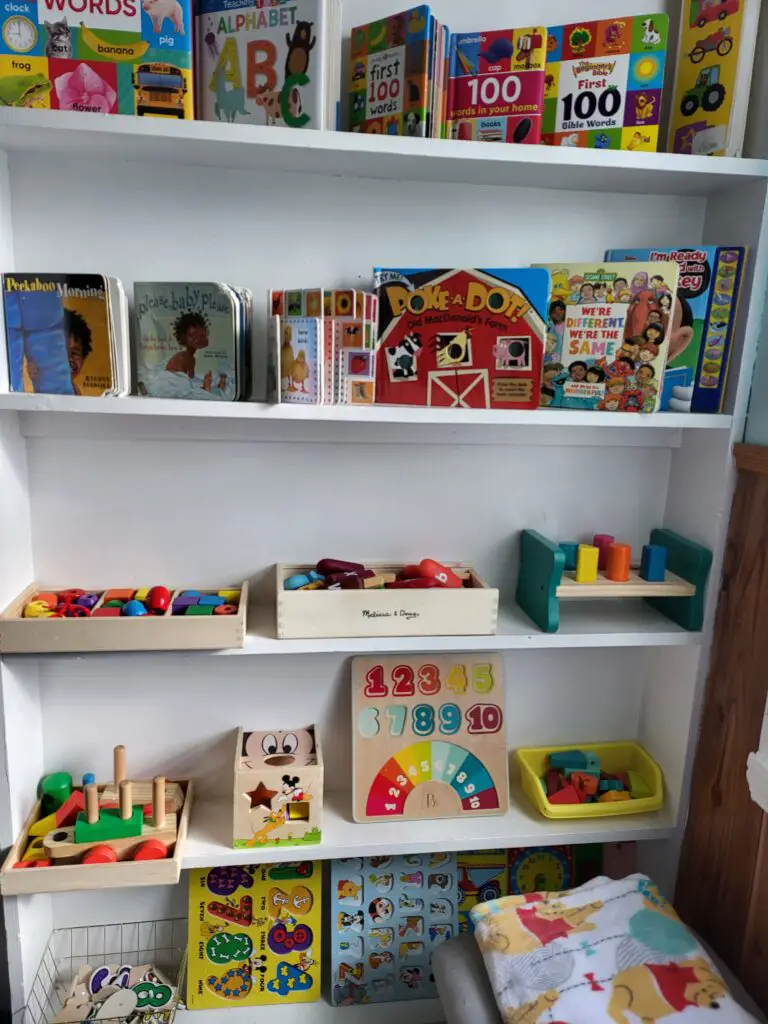
A little preparation goes a long way in creating a peaceful learning environment. You don't need a picture-perfect, dedicated schoolroom. A simple bookshelf, a few organized bins, and a clear kitchen table can work wonders. The real key is creating simple systems that serve your family, not the other way around.
Before that first official day, take some quiet time to pray over your home, your children, and your curriculum. Ask the Lord for wisdom, joy, and a spirit of gentleness. This simple act of surrender sets the tone for your entire year, reminding you that He is your ultimate guide and strength in this calling.
Finding Your Community and Support
Homeschooling doesn't mean you have to go it alone. In fact, finding a supportive community is one of the most important things you can do to truly thrive on this journey. Connecting with other families who share your faith and educational goals provides encouragement, accountability, and vital social opportunities for your children.
Look for support in these key places:
- Local Homeschool Co-ops: These groups can be a fantastic source of classes, fun field trips, and friendships for both kids and parents.
- Your Church Family: See if you can connect with other homeschooling families in your congregation for prayer support and shared activities.
- Online Forums and Groups: Digital communities can be an amazing resource for curriculum advice, practical tips, and much-needed, late-night encouragement from moms who just get it.
Remember, the curriculum is a tool, but community is a lifeline. Lean on others, share your struggles, and celebrate your victories together. This journey is so much richer when it's shared.
As you build your daily rhythm, don't forget to sprinkle in moments of joy and creativity. Supplementing your core lessons with hands-on projects can bring learning to life in a powerful way. For some great ideas, you can find a wonderful list of 10 fun and engaging Christian homeschool activities to keep your days fresh and exciting.
Common Questions About Christian Homeschool Curriculum
Choosing a Christian homeschool curriculum feels like a huge decision, and it’s natural for a few practical questions to pop up as you get closer to picking one. You might be wondering about the real cost, if you need to worry about accreditation, or how on earth you'll manage to teach kids of different ages all at once.
Getting straight answers to these common concerns can be the final piece of the puzzle, giving you the confidence you need to jump into homeschooling with peace and excitement. Let's tackle some of the most frequent questions we hear from parents just like you.
How Much Does Christian Homeschool Curriculum Cost?
The honest answer is: it varies—a lot! You can create a rich, faith-filled education using excellent free resources online, or you can invest in a comprehensive, all-in-one boxed curriculum that might cost over $1,000 for a single student. This huge range means there’s truly a path for every family budget.
Practically speaking, a realistic budget for a complete curriculum from a major publisher usually lands somewhere between $400 and $800 per child for the year. But many savvy homeschool families significantly cut down on costs by:
- Buying used curriculum from Facebook groups, co-ops, or online marketplaces.
- Making the local library their best friend for literature, history books, and science supplements.
- Mixing and matching different publishers to get the best value for each individual subject.
Are Christian Homeschool Programs Accredited?
This is probably one of the most common questions, and it’s a really important one. The answer isn't a simple yes or no. Some online Christian schools or full-service distance learning programs do offer formal accreditation. This can be a priority if you plan to transition your child back into a traditional school or have your eye on a specific, competitive college.
However, most curriculum publishers—the companies that sell the actual books and materials—are not accrediting agencies. Accreditation is rarely a legal requirement for homeschooling, but it's absolutely essential to check your specific state's laws. For the vast majority of college-bound homeschoolers, a strong transcript, a portfolio showcasing their best work, and solid scores on standardized tests like the SAT or ACT carry far more weight than an accredited diploma.
How Do I Teach Multiple Children at Different Ages?
Teaching several kids at once isn't just doable; it's often one of the greatest joys of homeschooling! It creates such a beautiful, family-centered learning atmosphere. In fact, many Christian curriculum creators design their programs specifically for this dynamic.
The secret is to look for curriculum that uses a "family-style" or multi-level learning approach, especially for subjects like history, science, Bible, and art. In this model, all your kids learn about the same big topic together. For instance, the whole family might study Ancient Rome. Your first-grader could draw a Roman chariot, while your middle schooler writes a short report on Julius Caesar, and your high schooler dives into the Punic Wars.
For skill-based subjects that build sequentially, like math and phonics, you’ll almost always need separate, grade-specific materials for each child.
Here at The Mom Resource, our heart is to help you find the perfect tools to build a joyful, faith-filled learning culture right in your own home. Check out our guides and printables to get your family set up for a successful year.