Your Guide to a Homeschool Curriculum for Kindergarten
When you start thinking about the best homeschool curriculum for kindergarten, it's easy to get bogged down in images of tiny desks and rigid schedules. But let's toss that idea right out the window. The best approach is a flexible one, built on play, discovery, and those crucial foundational skills—not a strict set of rules.
It’s really about creating a strong, well-rounded foundation that’s built just for your child. A great program strikes a beautiful balance between guided learning and free exploration, sparking that natural curiosity while gently building literacy, numeracy, and social-emotional skills.
What a Great Kindergarten Homeschool Curriculum Looks Like
Choosing an educational path for your kindergartener is a huge decision, but it truly doesn't have to be overwhelming. Instead of trying to replicate a traditional classroom at your kitchen table, think of this year as an opportunity to build a genuine love for learning. When you get it right, the curriculum feels more like a guided adventure than a pile of assignments.
This mindset is catching on. More and more families are seeking a personalized education, and the numbers show it. In fact, kindergarten homeschooling is projected to account for about 12% of all homeschooled students in the United States in 2025. That's a significant jump from just 8% back in 2016, and it points to a growing desire for a gentle, child-led start to education.
The Core Elements of Success
At its heart, a high-quality kindergarten curriculum is built on a few key pillars. These aren't just buzzwords; they are the components that work together to nurture your child’s development in a balanced way, making sure they grow academically, socially, and emotionally.
To help you sift through the options, I've put together a table that breaks down the essential components you should look for. Think of this as your quick-reference guide when you're comparing different programs.
Core Components of a High-Quality Kindergarten Curriculum
| Component | What It Means for Your Child | Example Activity |
|---|---|---|
| Play-Based Learning | Learning concepts naturally through games, imagination, and hands-on fun. It feels like play, not work. | Sorting colorful bears by size and color to learn about patterns and counting. |
| Rich Literature | Being exposed to beautiful picture books and classic stories that build vocabulary and spark important conversations. | Reading The Very Hungry Caterpillar and then sequencing the story with picture cards. |
| Hands-On Activities | Getting to build, create, and interact with physical materials. This is how abstract ideas become concrete. | Using blocks to build a tower and measuring its height with a ruler. |
| Real-World Connections | Seeing how lessons connect to their everyday life, which makes learning meaningful and relevant. | Helping to bake cookies and measuring ingredients to practice fractions and following directions. |
This table helps illustrate how these components come together to create a rich, engaging learning environment far beyond what simple worksheets can offer.
A great curriculum doesn't just teach your child what to think; it teaches them how to learn. It builds curiosity, resilience, and a deep-seated confidence that will serve them for years to come.
Tailoring the Experience to Your Child
The real magic of homeschooling is the ability to customize everything for your unique child. To do this well, it’s helpful to understand key childhood development milestones. This ensures your plans align with where your child is right now. Ask yourself: Does my child learn best by moving their body, listening to stories, or working with their hands?
A truly effective curriculum gives you the flexibility to adapt on the fly. If your child suddenly becomes fascinated by dinosaurs, you can lean into it. Build an entire unit around them, covering science, math (counting fossils!), and art. This child-led approach is what makes learning stick. It feels exciting, not forced.
For those of you just starting this journey, getting the basics right is everything. You might want to check out our broader guide on the best homeschool curriculum for beginners for more foundational tips on creating a learning environment where your child can truly thrive.
Laying the Foundation with Core Kindergarten Subjects
When you're putting together a homeschool curriculum for kindergarten, it’s easy to get hung up on the core subjects. But this isn't about recreating a stuffy classroom with rigid time blocks. Think of each subject as a different pair of glasses your child can wear to see and make sense of the world.
The real magic happens when you weave these foundational ideas into the fabric of your day-to-day life. When learning feels as natural as breathing, abstract concepts click into place. Your kitchen becomes a math lab, the backyard transforms into a science station, and every trip to the living room is an adventure in a library.
Igniting a Lifelong Love for Literacy
Kindergarten literacy is so much more than drilling the alphabet. It’s about falling head-over-heels in love with stories, discovering that squiggly lines make sounds, and having that lightbulb moment when they realize those sounds create the words we speak every single day. The goal here is pure, simple joy in language.
This all starts with one of the most powerful things you can do: reading aloud daily. It’s that simple. Cuddling up with a good book builds their vocabulary, shows them how stories work, and models what expressive reading sounds like.
From there, you can sprinkle in gentle, play-based activities:
- Letter Hunts: Hide magnetic letters around the house and have your little one find them. "You found the 'B'! B says /b/ like in 'ball'!"
- Storytelling Prompts: Keep a "story basket" with silly hats, weird objects, or picture cards to spark their imagination and get them telling their own simple tales.
- Environmental Print: Point out words everywhere you go—on the cereal box, on street signs, on store logos. This shows them that words have a real, tangible job to do in the world.
When you focus on connection over correction, you're not just teaching a skill; you're nurturing a passionate, lifelong reader.
Making Math a Hands-On Adventure
At this age, math needs to be a physical, hands-on experience. Before a child can really understand the abstract idea of "five," they need to hold five blocks in their hand, count five crackers for a snack, and watch five ducks swim in a pond. Your homeschool curriculum for kindergarten should be full of these concrete moments, not worksheets.
Believe it or not, your daily routines are already packed with organic math lessons. Cooking together involves measuring (hello, fractions!), setting the table teaches one-to-one correspondence, and sorting laundry is a lesson in classification.
At the kindergarten level, math isn't about finding the right answer in a workbook. It’s about building "number sense"—an intuitive understanding of what numbers mean and how they relate to each other.
To build this intuition, try incorporating simple games and tools into your day. For those who love a tactile approach, exploring some of the best Montessori materials for math can be a game-changer, offering incredible hands-on tools for making numbers visible.
Here are a few other easy ways to make math playful:
- Shape Detective: On your next walk, turn it into a game to see who can find the most circles, squares, and triangles.
- Counting Games: Count the stairs as you climb them, the red cars you pass on a drive, or the blueberries on their plate.
- Pattern Practice: Use LEGOs, colorful beads, or even fruit slices to create simple patterns (e.g., grape, strawberry, grape, strawberry).
Exploring the World Through Science
Kindergarten science is just pure, unadulterated curiosity. Forget memorizing facts. This is all about asking questions, making observations, and poking around the natural world with wide-eyed wonder. Your job is less "teacher" and more "fellow explorer."
The world is your laboratory. A walk in the park becomes a lesson on changing seasons. A rainy day is a perfect chance to talk about where water comes from. Planting a single seed in a cup introduces the entire concept of life cycles. Just encourage those "Why?" and "What if?" questions, and then have fun finding the answers together.
Try a few of these simple science activities:
- Nature Journaling: Collect an interesting leaf or flower on your walk and try to draw it in a notebook.
- Sink or Float: Gather a few small household objects, predict whether they will sink or float in a bowl of water, and then test your theories!
- Weather Charting: Keep a simple chart where you draw a picture of the weather each day. Talk about how it changes and why.
These little investigations cultivate the critical thinking and observation skills that are the bedrock of all scientific discovery.
Understanding Our Place with Social Studies
For a five-year-old, social studies starts with their own little world and ripples outward. It’s about understanding themselves, their family, their neighborhood, and their small but important place in it all. This is how we start building empathy and a sense of belonging.
One of the most classic kindergarten projects is the "Me on the Map" activity. It helps a child physically see their place in the world, starting with their house, then their street, their city, their state, and so on. It's a simple idea with a powerful impact on how they understand community.
Other key social studies topics can be woven into your days:
- Community Helpers: Learning about firefighters, doctors, and librarians helps kids see the different jobs people do to make a community work.
- Family Traditions: Talking about your family's unique holidays and traditions is a gentle introduction to culture.
- Basic Needs: Discussing how everyone needs food, shelter, and love builds a foundation for empathy and global awareness.
By grounding these big ideas in your child's direct experience, you make them relatable and meaningful, laying the first stones on the path to becoming a thoughtful, engaged citizen.
Developing Essential Skills Beyond the Books
While core subjects like reading and math are the backbone of any strong homeschool curriculum for kindergarten, they're only part of the story. A truly powerful early education nurtures the whole child, zeroing in on the critical skills that set them up for a lifetime of learning.
Think of it this way: if academics are the bricks, these foundational skills are the mortar holding everything together. They provide the stability and strength your child needs to truly thrive, and they’re built not through worksheets, but through movement, play, and connection.
Strengthening Little Hands for Big Tasks
Before a child can ever hold a pencil correctly to write their name, they have to develop fine motor skills. These are the small, precise movements using the tiny muscles in their hands and fingers. Rushing this can lead to frustration and a poor pencil grip down the road, so focusing on strengthening these muscles first is absolutely key.
Imagine asking a child to build a detailed LEGO set while wearing thick winter mittens. That’s what writing feels like for little hands that aren't quite ready. Our goal is to gently take those "mittens off" through joyful, no-pressure activities that just feel like play.
Here are a few simple but powerful ways to build that crucial hand strength:
- Play-Dough Power: Squeezing, rolling, and pinching modeling clay is a fantastic workout for little hands.
- Threading and Lacing: Using chunky beads and a shoelace to make a necklace or using lacing cards helps develop hand-eye coordination and the pincer grasp needed for writing.
- Scissor Skills: Start with safety scissors and let them snip play-dough. From there, you can move on to cutting along straight and then curvy lines on paper.
These activities are the real groundwork for beautiful handwriting later on. They make the physical act of writing feel natural and easy when the time finally comes.
Building Strong Bodies and Brains
Just as important as those tiny hand movements are the big, whole-body actions that build gross motor skills. Running, jumping, climbing, and skipping aren't just for burning off energy; they're vital for brain development. These large-scale movements build core strength, balance, and spatial awareness.
This physical development is directly linked to a child's ability to eventually sit still and focus. A child who has had plenty of time to move their body is far better prepared to engage in quiet, seated learning activities.
Think of it this way: Gross motor play wires the brain's "superhighways," while fine motor activities build the smaller "local roads." You need both to have a fully connected and efficient system for learning.
Weaving gross motor work into your homeschool day is often the most fun part. It can be as simple as an impromptu dance party, a game of "Simon Says," or building an obstacle course in the living room with pillows and blankets. These moments are just as educational as any lesson. To keep things fresh, you can find lots of engaging homeschool activities for kindergarten that promote this kind of essential, hands-on development.
Nurturing the Heart: Social-Emotional Learning
Perhaps the most crucial skill set of all is Social-Emotional Learning (SEL). This is all about learning to understand and manage big feelings, show empathy, build positive relationships, and make good decisions. Kindergarten is a prime time for this, as children start navigating more complex social situations.
In a homeschool setting, you have the unique gift of being able to model and discuss these skills in real-time. A squabble over a toy becomes a teachable moment about sharing and perspective. A block tower that keeps falling over is a chance to talk about perseverance and handling disappointment.
Here are some practical ways to weave SEL into your day:
- Name That Feeling: Use a chart with faces showing different emotions (happy, sad, angry, surprised) and chat about what might make someone feel that way.
- Read Emotion-Rich Stories: Pick books where characters experience strong feelings and talk about them. Ask questions like, "How do you think the bear felt when he lost his hat?"
- Practice Problem-Solving: When a conflict pops up, guide your child through finding a solution together instead of just stepping in and fixing it for them.
By intentionally focusing on these whole-child skills, you're doing so much more than just teaching academics. You're giving your child the coordination, confidence, and compassion they need to succeed not just in school, but in every part of their life.
Choosing Your Approach to Homeschooling
Every family moves to its own unique rhythm, and your homeschool curriculum for kindergarten should honor that. Before you grab the first curriculum you see, it’s worth taking a moment to think about the educational philosophy that truly lines up with your family’s values and your child’s natural way of learning.
Think of this as choosing the operating system for your homeschool. It doesn’t just dictate what you teach, but how you teach it. Settling on an approach acts as a fantastic filter, making it so much easier to sort through the endless options and find resources that actually resonate with your family. Instead of feeling totally overwhelmed, you can focus on materials that create a cohesive, enjoyable learning environment for everyone.
The Montessori Inspired Method
The Montessori approach is built on a deep respect for the child as a capable, independent individual. It’s all about child-led, hands-on learning within a carefully prepared environment. In this model, you act less like a traditional teacher and more like a guide, observing your child’s interests and presenting materials that meet them right where they are developmentally.
A core belief here is that kids learn best through direct experience and self-discovery. This means less time with worksheets and more time with tangible, self-correcting materials that let them explore big concepts like counting, sorting, and practical life skills at their own pace.
What this looks like in practice: Your learning space might have low, accessible shelves holding a curated selection of activities. For math, your child might use wooden beads to physically build numbers. For life skills, they might practice pouring water between two small pitchers. The goal is purposeful work that builds deep concentration and independence.
The Charlotte Mason Philosophy
The Charlotte Mason philosophy is a gentle, literature-rich approach built on the idea that education is an atmosphere, a discipline, and a life. It steers clear of dry, boring textbooks in favor of "living books"—beautifully written narratives that make subjects like history and science come alive. Nature study is also a huge cornerstone, encouraging kids to spend plenty of time outdoors observing the world firsthand.
This method uses short, focused lessons to hold a young child’s attention and build good habits. It also weaves in art, music appreciation, and narration, where a child tells back what they’ve learned in their own words—an incredibly powerful tool for building comprehension. If you're curious about how this compares to other methods, you can learn more about the differences between the Charlotte Mason and Maria Montessori learning methods in our detailed article.
What this looks like in practice: Your day could start with a 15-minute phonics lesson, followed by reading a chapter from a classic children's story. Afterward, you might head outside for a nature walk, where your child sketches a flower they found in their nature journal.
This decision tree infographic can help you visualize how your child's primary learning style might point you toward a compatible homeschooling path.
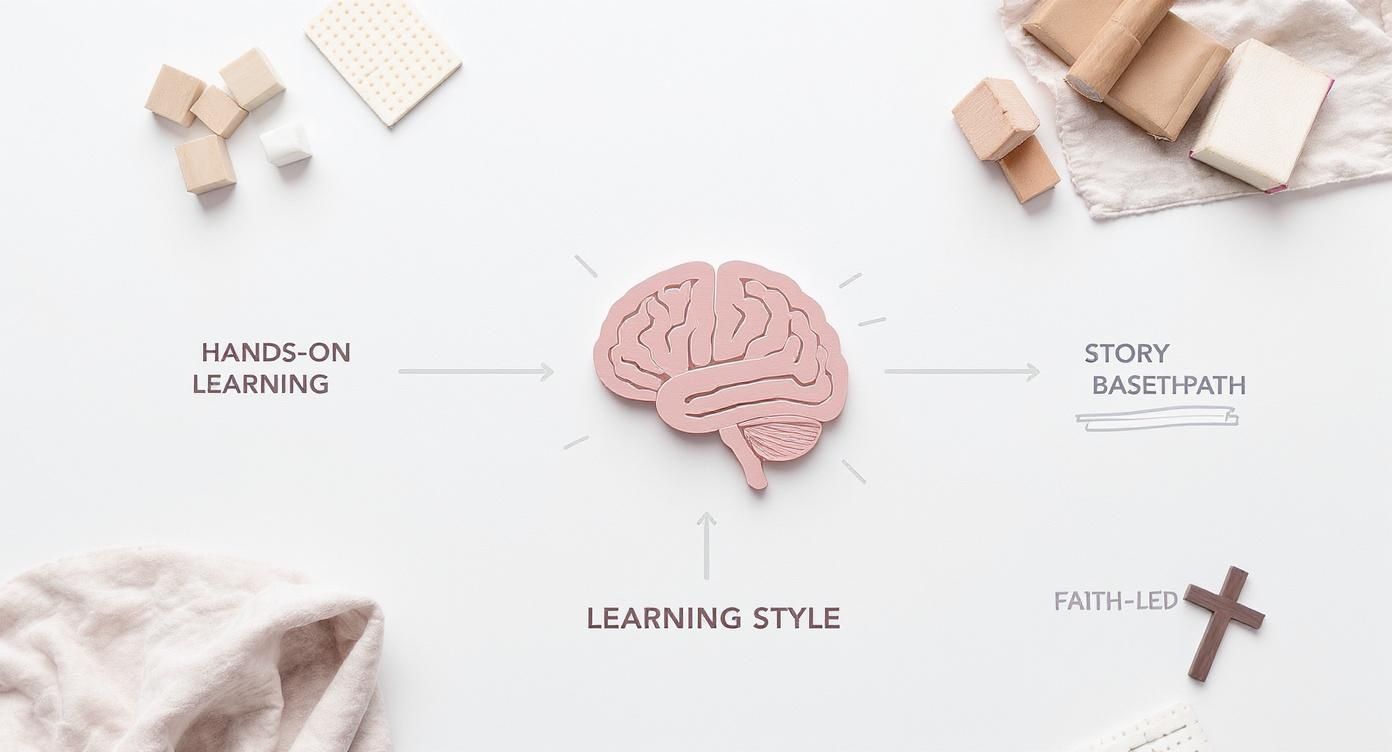
As you can see, there isn't one "right" way to homeschool. The best approach is always the one that harmonizes with your child's innate tendencies and your family's core values.
Choosing a homeschool philosophy can feel like a big decision, but it's really about finding a framework that fits your family's unique personality. The table below breaks down three popular approaches to help you see which one might be the best starting point for you.
Comparing Popular Kindergarten Homeschooling Philosophies
| Philosophy | Core Principle | Learning Environment | Best For Children Who… |
|---|---|---|---|
| Montessori | Child-led, hands-on discovery | Prepared, orderly, with accessible, self-correcting materials | Are independent, kinesthetic, and thrive on structure and order. |
| Charlotte Mason | Education is "an atmosphere, a discipline, a life" | Nature-rich, filled with "living books," art, and music | Are imaginative, love stories, and learn well through narration and observation. |
| Faith-Based | All knowledge points back to a Creator | Varies, but integrates scripture and worldview into all subjects | Families who want to seamlessly weave their spiritual values into every academic subject. |
Ultimately, many families find they don't stick rigidly to one single philosophy. It's perfectly okay—and often wonderful—to pull your favorite elements from different approaches to create a custom blend that works just right for your kindergartener.
The Faith Based Approach
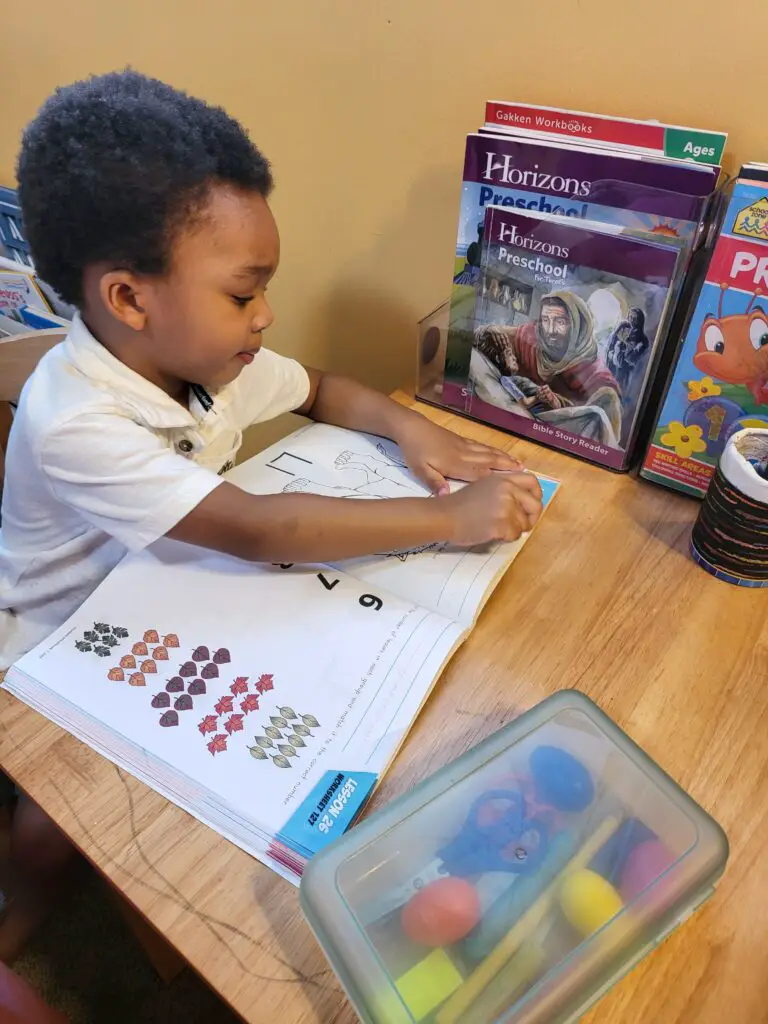
For many families, integrating faith into every corner of learning is the number one priority. A faith-based approach isn’t just about adding a Bible lesson to your day; it’s about weaving spiritual values and a biblical worldview into every single subject. Science lessons might highlight the wonder of creation, while history is viewed through the lens of a divine plan.
This method aims to nurture a child’s character right alongside their academic skills, emphasizing virtues like kindness, diligence, and integrity. The curriculum choices here are vast, ranging from programs that lightly sprinkle in scripture to those that are fully centered on religious texts.
The core idea behind a faith-based education is to teach children that learning is an act of worship and that all knowledge ultimately points back to a Creator. This perspective shapes not only the content but also the heart and motivation behind the learning process.
What this looks like in practice: You might use a language arts curriculum that uses Bible stories to teach reading and handwriting. A science unit on animals could include discussions about God’s creativity and His care for all living things. The goal is to create a seamless, natural connection between academic growth and spiritual formation.
Creating a Simple and Sustainable Homeschool Schedule
One of the fastest ways to burn out is trying to replicate a seven-hour public school day at home. It just doesn't work. A sustainable homeschool curriculum for kindergarten thrives on a gentle, predictable daily rhythm, not a rigid, clock-driven schedule. This approach protects your child’s natural love for learning—and your own sanity.
Think of your day as a collection of "building blocks." You have blocks for learning, for free play, for getting outside, for meals, and for chores. Your only job is to arrange these blocks in an order that feels natural for your family. You're creating a flow, not a list of demands.
This flexible mindset is a huge reason so many families are choosing to homeschool. The number of homeschooled students hit 3.7 million in 2021, and after a little fluctuation, it returned to that number in 2024. Kindergarteners are consistently a growing part of this trend, which tells us parents are seeing the value in a more personal, connected start to their child's education. You can find more homeschooling statistics and insights on brighterly.com.
The Power of Rhythm Over Rigidity
A daily rhythm gives kids the predictability they crave without the constant pressure of a ticking clock. It simply means your child knows that after breakfast, we read stories. After stories, we play outside. The exact timing might shift from day to day, but the comforting sequence stays the same.
This structure helps children feel secure and makes transitioning between activities so much smoother. It also empowers them by letting them know what’s coming next, which can dramatically reduce resistance and build a sense of independence.
A successful homeschool rhythm feels less like a performance you have to perfectly execute and more like a dance you and your child learn together. Some days are graceful, others are a bit clumsy, but you’re always moving forward in partnership.
An Adaptable Sample Daily Rhythm
Please, think of this as a starting point, not a strict rulebook! Watch your child’s energy and your family’s natural flow, and then shuffle the blocks to fit your real life. Remember, a joyful 15-minute lesson with an engaged child is worth far more than a forced hour of misery.
Morning Block (Creative & Focused Energy)
- 7:30-8:30 AM Wake Up, Breakfast & Morning Chores (like making their bed or feeding a pet)
- 8:30-9:00 AM Morning Basket & Read-Aloud (a cozy time for poetry, stories, or music)
- 9:00-9:30 AM Focused Learning (a short, 15-minute lesson in phonics or math)
- 9:30-11:00 AM Free Play & Outdoor Time (absolutely essential for their growing bodies!)
Midday Block (Winding Down & Refueling)
- 11:00-12:00 PM Hands-On Activity (think crafts, baking, or a sensory bin)
- 12:00-1:00 PM Lunch & Quiet Time (listen to an audiobook or look at picture books)
Afternoon Block (Exploration & Connection)
- 1:00-3:00 PM Outing or More Outdoor Play (a trip to the park, library, or a nature walk)
- 3:00-4:00 PM Snack & Independent Play (LEGOs, drawing, puzzles)
- 4:00 PM Onward Family Time & Evening Routine
Keeping Simple Records
Record-keeping for kindergarten doesn't have to be some soul-crushing administrative task. While requirements vary by state, the goal is simply to show that learning is happening. For a five-year-old, this can be incredibly simple and even fun.
Try one of these low-stress methods:
- A Photo Journal: Just snap a quick picture on your phone each day of your child engaged in an activity. A photo of them counting rocks outside or building a block tower is a powerful record of learning in action.
- A Simple Binder: Grab a three-ring binder and add dividers for each subject. Once a week, slip in a work sample—a drawing, a handwriting sheet, or a list of the library books you read together.
- A Weekly Log: Keep a small notebook where you jot down a few sentences at the end of the week. Note a concept they mastered ("finally understood what 'rhyming' means!"), a fun field trip you took, or a really interesting question they asked.
This process is meant to serve you, not the other way around. Pick the easiest method that meets your needs and helps you see and appreciate all the amazing learning that’s happening every single day.
Your Homeschool Kindergarten Questions Answered
Starting your homeschool journey can feel like standing at the edge of a huge, exciting new world. It’s completely normal for that excitement to be mixed with a healthy dose of questions and maybe even a few worries. This is your chance to get those common concerns addressed so you can step forward with confidence and peace of mind.
Let's tackle some of the most frequent questions parents have when designing their homeschool curriculum for kindergarten. These are the practical, real-world concerns that pop up once you move from planning to doing.
How Many Hours a Day Should I Homeschool My Kindergartener?
This is often the first question on every parent's mind, and the answer is refreshingly simple: much less time than you might think. The goal in kindergarten is quality and connection, not quantity.
Most experienced homeschooling families recommend about 60 to 90 minutes of focused, structured learning activities per day. Critically, this time should be broken down into very small, manageable chunks of just 15-20 minutes each. This short-burst approach respects a five-year-old's natural attention span and keeps learning joyful instead of draining.
So, what does that actually look like?
- 15 minutes of cuddling on the couch reading a few picture books together.
- 20 minutes playing a hands-on math game, like sorting and counting colorful pom-poms.
- 15 minutes practicing letter sounds with magnetic tiles on the fridge.
The rest of the day isn't empty time; it's filled with some of the most important learning of all. This is where free play, exploring outdoors, "helping" with household chores, and simply being together come in. A gentle, flexible rhythm is far more effective and developmentally appropriate than trying to recreate a traditional school day at home.
Do I Need to Buy an Expensive All In One Curriculum?
Absolutely not. While comprehensive, all-in-one "boxed" curricula offer convenience, they are by no means a requirement for a rich and successful kindergarten experience. In fact, many families find greater joy and success by taking a more eclectic, mix-and-match approach.
This means you can hand-pick the resources that truly fit your child and your family. You might pull a phonics program you love, use library books for science and history, and rely on free online printables for math games. Your local library is one of the most powerful and cost-effective tools in your homeschool arsenal.
The most important ingredients for a successful kindergarten year are not found in a box. They are your loving engagement, a curious and nurturing environment, and the freedom to follow your child's interests.
Ultimately, the best homeschool curriculum for kindergarten is the one that aligns with your child's unique learning style, your family’s budget, and your overall lifestyle. Your presence is the most valuable resource you can offer.
How Do I Know if My Child Is Learning Enough?
This is the big one—the question that can keep parents up at night. In a world of standardized tests and classroom comparisons, it’s natural to worry about "keeping up." But the beauty of homeschooling is that you get to step off that hamster wheel entirely.
In kindergarten, progress is best measured through gentle observation, not formal tests. Learning at this age is not linear; it happens in bursts and is woven into the fabric of everyday life. Instead of looking for test scores, look for signs of growth and engagement.
Ask yourself these questions:
- Are they showing a greater interest in books and asking you to read more often?
- Can they recognize more letters and their corresponding sounds than they could a month ago?
- Are they asking thoughtful questions about the world around them during a nature walk?
- Do they attempt to write letters or their name on drawings?
These are all powerful indicators of learning. A wonderful way to track this progress is by keeping a simple portfolio. Just collect samples of their drawings, writing attempts, and photos of their block creations or science experiments throughout the year. When you look back, you will be absolutely amazed at how far they've come. Remember, children develop at their own unique pace, and homeschooling gives you the gift of honoring that timeline perfectly.
At The Mom Resource, we believe in equipping you with the confidence and tools to create a joyful, faith-filled learning environment at home. Explore our resources and join our community to find the support you need for every step of your journey. https://themomresource.com