10 Faith-Friendly Homeschool Field Trip Ideas for 2025
One of the greatest advantages of homeschooling is the freedom to turn the world into your classroom. Moving beyond textbooks and worksheets, field trips offer immersive, hands-on learning experiences that bring abstract concepts to life. A well-planned outing can ignite a child's curiosity, deepen their understanding of a subject, and create lasting family memories. However, the challenge often lies in finding fresh, educational, and engaging homeschool field trip ideas that align with your curriculum and family values.
This comprehensive guide is designed to solve that problem. We've curated a diverse collection of destinations that transform learning from a passive activity into an active adventure. Forget generic suggestions; this list provides actionable strategies for maximizing the educational value of every outing. You'll find practical tips for integrating these trips into your lesson plans, whether you're studying ancient history, biology, civics, or art.
Inside this guide, you will discover:
- Categorized Trip Ideas: From science museums and historical sites to botanical gardens and working farms.
- Practical Planning Tools: Age recommendations, subject connections, and specific learning objectives for each location.
- Pre and Post-Trip Activities: Printable checklists and discussion prompts to extend the learning before you go and after you return.
- Faith-Friendly Perspectives: Suggestions for connecting experiences to your family’s spiritual values and worldview.
Our goal is to equip you with the resources needed to create meaningful educational journeys. These are more than just days out; they are opportunities to foster a genuine love for learning, strengthen family bonds, and help your children see their studies reflected in the world around them. Let's explore the incredible learning adventures that await.
1. Science and Natural History Museums
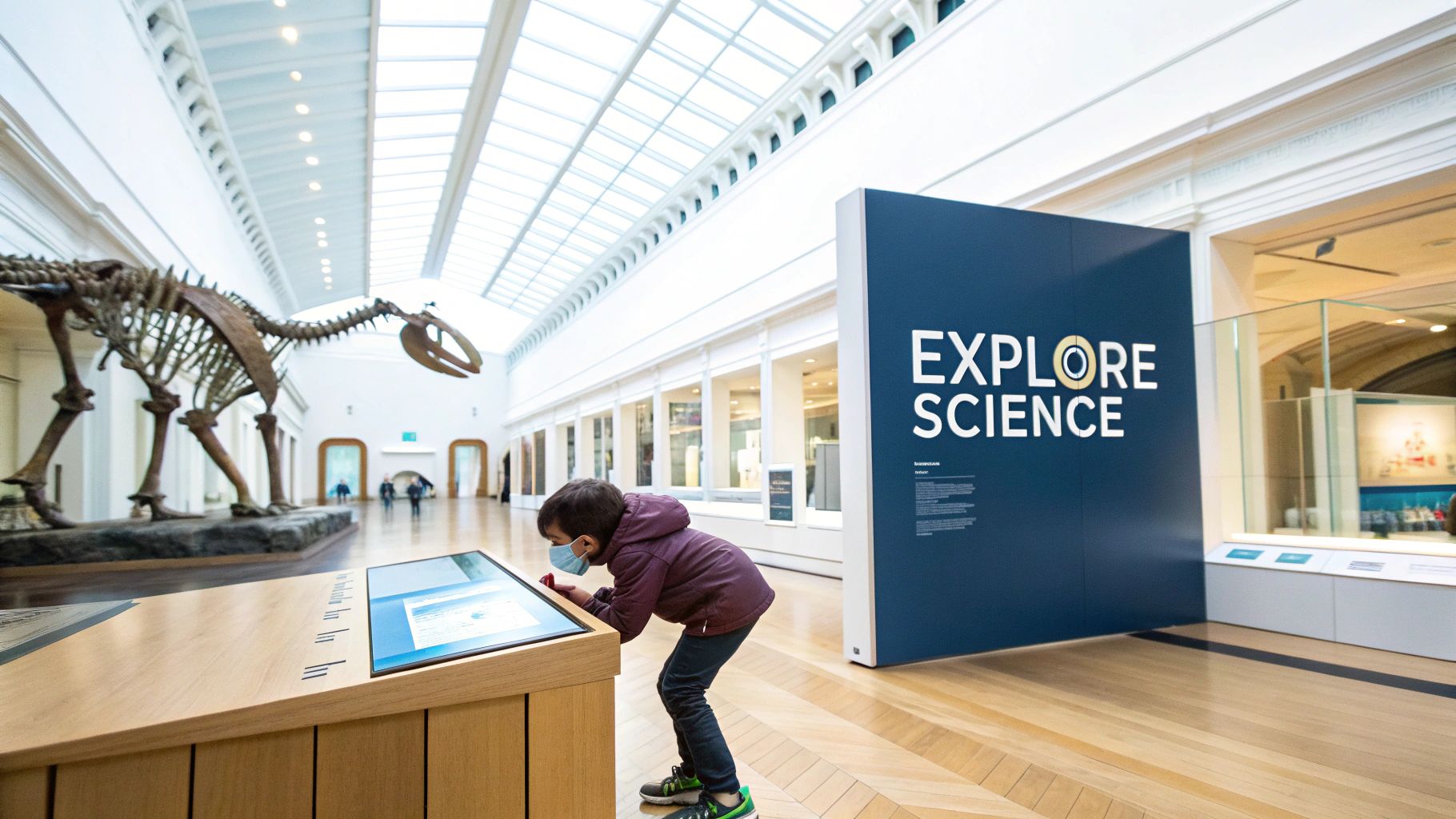
A visit to a science or natural history museum is a cornerstone of experiential education, offering an immersive environment where abstract curriculum concepts become tangible realities. These institutions serve as dynamic, interactive classrooms, providing homeschoolers with direct access to everything from colossal dinosaur skeletons and ancient artifacts to hands-on physics experiments and detailed dioramas of diverse ecosystems. This type of field trip transforms learning from a passive activity into an active exploration.
Why It’s a Great Homeschool Field Trip Idea
Museums are powerful educational tools because they cater to multiple learning styles simultaneously. A visual learner can absorb information from a detailed exhibit, an auditory learner can benefit from a guided tour or documentary, and a kinesthetic learner can engage with interactive displays. A single trip can cover biology, earth science, physics, and history, making it one of the most efficient and impactful homeschool field trip ideas. Many institutions, like the Smithsonian National Museum of Natural History in Washington, D.C., or the California Academy of Sciences in San Francisco, offer specialized homeschool days or educational workshops that align with state learning standards.
How to Make Your Museum Visit a Success
To maximize the educational value and enjoyment of your visit, thoughtful preparation is key.
- Plan Ahead: Visit the museum’s website to check for homeschool group rates, special programs, and educator resources. Planning your trip during off-peak hours, such as a weekday morning, can help avoid crowds and allow for a more focused experience.
- Create a Mission: Instead of aimless wandering, give your students a purpose. Create a simple scavenger hunt or a "photo journal" assignment where they must find and photograph specific exhibits related to their current studies.
- Empower Exploration: While structure is helpful, also build in free time. Allowing children to follow their own curiosity and spend extra time at exhibits that capture their interest fosters a genuine love for learning.
- Post-Trip Reinforcement: After the visit, have students create a presentation, write a report, or build a model based on their favorite exhibit. This helps solidify what they learned and connects the experience back to your home curriculum.
2. Historical Sites and Living History Museums
Stepping onto a preserved battlefield or walking through a colonial village offers a history lesson that no textbook can replicate. Historical sites and living history museums provide an immersive journey into the past, allowing students to see, hear, and even smell what life was like in a different era. These locations bring history to life through preserved artifacts, authentic architecture, and costumed interpreters who demonstrate period-specific crafts and daily routines. This field trip idea transforms abstract historical dates and events into a memorable, multi-sensory human story.
Why It’s a Great Homeschool Field Trip Idea
Living history museums are exceptionally effective because they connect students directly with the subject matter. Instead of just reading about blacksmithing, children can feel the heat from the forge and watch a smith at work. This approach caters to all learning styles and fosters a deeper, more personal connection to history. A trip to a place like Colonial Williamsburg in Virginia or Plimoth Patuxet Museums in Massachusetts provides context for understanding government, culture, and daily life, making these excellent homeschool field trip ideas for social studies, civics, and literature.
How to Make Your Historical Site Visit a Success
Careful planning can turn a good visit into an unforgettable educational experience.
- Provide Context: Before you go, read books or watch documentaries about the specific time period. Understanding the historical context helps students appreciate the significance of what they are seeing and enables them to ask more insightful questions.
- Prepare for Interaction: Encourage your children to think of questions to ask the costumed interpreters. These experts are a primary resource, ready to share detailed knowledge about their trade, clothing, and the challenges of the era.
- Create a Timeline: After your visit, work together to create a timeline that places the historical site’s period in the larger context of world history. This helps students organize information and see the connections between different events.
- Journal from the Past: Encourage students to write a journal entry from the perspective of someone living during that time period. This creative writing exercise helps them process what they learned and develop empathy for historical figures.
3. Botanical Gardens and Arboretums
A trip to a botanical garden or arboretum offers a living classroom where students can experience the wonders of the plant kingdom firsthand. These meticulously curated spaces go far beyond a simple walk in the park, providing immersive lessons in botany, ecology, and environmental science. From themed collections like Japanese gardens and medicinal herb plots to expansive greenhouses showcasing tropical rainforests and arid deserts, these locations transform abstract biology concepts into vibrant, sensory experiences.

Why It’s a Great Homeschool Field Trip Idea
Botanical gardens excel at connecting curriculum to the real world, making them one of the best homeschool field trip ideas for multi-sensory learning. Students can see, touch, and smell diverse plant life, reinforcing lessons on plant life cycles, adaptation, and biodiversity. Institutions like the New York Botanical Garden or the Desert Botanical Garden in Arizona offer dedicated educational programs and self-guided tour materials for families. This approach aligns beautifully with educational philosophies that emphasize direct observation of nature, providing a perfect setting for activities like nature journaling. For more ideas on incorporating this style of learning, you can explore the Charlotte Mason homeschool method.
How to Make Your Botanical Garden Visit a Success
To cultivate a rich educational experience, a little planning can make your visit blossom.
- Choose a Focus: Before you go, decide on a theme for your visit. You might focus on identifying native plants, sketching different leaf shapes, exploring pollinator gardens, or learning about plant adaptations in a specific biome like a desert conservatory.
- Pack a Nature Study Kit: Equip your students with tools for exploration. A field guide, a sketchbook or nature journal, colored pencils, and a magnifying glass can turn a simple walk into a scientific investigation.
- Use Technology to Enhance Learning: Download a plant identification app like PictureThis or Seek by iNaturalist. It gamifies the experience as students can "capture" and identify different species they encounter, creating a digital field journal of their discoveries.
- Post-Trip Activities: Extend the learning at home. Press flowers collected during your visit (where permitted), start a small container garden with seeds inspired by the trip, or have students research and present on a fascinating plant they discovered.
4. Art Museums and Galleries
A trip to an art museum or gallery immerses students in the world of human creativity, offering a visual journey through history, culture, and emotion. These spaces provide a unique educational setting where homeschoolers can encounter masterpieces firsthand, moving beyond textbook reproductions to appreciate the scale, texture, and impact of original works. This type of field trip nurtures aesthetic appreciation, critical thinking, and an understanding of diverse cultural perspectives.
Why It’s a Great Homeschool Field Trip Idea
Art museums are incredible resources for cross-curricular learning, seamlessly blending art history with world history, social studies, and even literature. Observing a Renaissance painting or a piece of modern sculpture can spark conversations about the historical context, the artist's life, and the techniques used. This direct engagement develops visual literacy and analytical skills. Institutions like The Metropolitan Museum of Art in New York or the Art Institute of Chicago offer family guides and audio tours that make their vast collections accessible and engaging for all ages, making them excellent homeschool field trip ideas.
How to Make Your Museum Visit a Success
A successful art museum visit is about quality, not quantity. Thoughtful planning can transform a potentially overwhelming experience into an inspiring one.
- Be Selective: Don't try to see the whole museum in one day. Before you go, browse the museum's online collection with your child and choose 3-5 specific pieces or one particular gallery to focus on.
- Encourage Active Looking: Give your students a sketchbook and pencil. Encourage them to find a piece they like and spend time sketching it, noting details, colors, and their personal response to the work.
- Discuss and Analyze: Use open-ended questions to spark conversation. Ask things like, "What do you think is happening in this painting?" or "How does this sculpture make you feel?" This encourages personal interpretation rather than just memorizing facts.
- Create a Post-Trip Project: Extend the learning at home by having students create their own artwork inspired by a style or artist they discovered. They could try pointillism like Seurat or expressive brushstrokes like Van Gogh.
5. Working Farms and Agricultural Centers
A trip to a working farm or agricultural center connects students directly to the source of their food, bridging the gap between grocery store aisles and the natural world. These living classrooms offer an unparalleled, multi-sensory experience where children can learn about biology, ecology, and economics through direct observation and participation. From milking a cow to picking apples straight from the tree, this type of field trip demystifies food production and instills a deeper appreciation for agriculture.
Why It’s a Great Homeschool Field Trip Idea
Farms provide a rich, hands-on learning environment that makes abstract concepts like life cycles, supply chains, and animal husbandry tangible. A visit can cover botany as students learn about plant growth, animal science through interactions with livestock, and even economics by discussing how produce gets from the farm to the market. Many local farms and agricultural centers offer structured educational tours, workshops, or even volunteer opportunities specifically for homeschool groups. Partnering with other families for these outings can be a great social opportunity, similar to the community found when you learn more about homeschool co-ops. These visits are among the most memorable homeschool field trip ideas because they engage all the senses and create lasting connections to the natural world.
How to Make Your Farm Visit a Success
Careful planning can turn a fun day out into a powerful educational experience that complements your curriculum.
- Plan Ahead: Contact the farm or agricultural center to inquire about their educational programs, tour availability, and any specific guidelines. Ask what activities will be available during your visit, as they often change with the seasons. Remember to dress for the weather and wear sturdy, closed-toe shoes.
- Create a Mission: Tailor the trip to your learning goals. If you're studying botany, focus on the crops. For an animal science lesson, prepare questions about the livestock's care, diet, and life cycle. A simple "I Spy" game for different types of farm equipment can also be a fun, engaging activity for younger children.
- Empower Exploration: Encourage your children to ask the farmers questions. Their firsthand knowledge is an invaluable resource. Let students get their hands dirty by participating in available activities, such as feeding animals, harvesting produce, or learning to churn butter.
- Post-Trip Reinforcement: Connect the farm experience back home. Use the produce you picked to cook a meal together, start a small container garden, or have your students write a story from the perspective of a farm animal. These follow-up activities help solidify the lessons learned during your visit.
6. Science Centers and Technology Museums
Where natural history museums focus on the past, science centers and technology museums bring the principles of STEM (Science, Technology, Engineering, and Math) into the present and future. These dynamic facilities are designed for interaction, featuring hands-on exhibits, working demonstrations, and technology-focused learning experiences. A trip to a science center allows students to physically engage with concepts like electricity, robotics, physics, and coding, turning abstract theories into practical, memorable lessons.
Why It’s a Great Homeschool Field Trip Idea
Science centers are essentially large-scale laboratories built for curiosity and experimentation. They empower students to learn by doing, which is particularly effective for kinesthetic learners who thrive on active engagement. These spaces encourage critical thinking, problem-solving, and innovation as children test hypotheses and observe immediate results. Institutions like the Exploratorium in San Francisco or the Museum of Science in Boston are masters at making complex topics accessible and exciting. This type of outing is one of the most engaging homeschool field trip ideas for sparking a lifelong interest in STEM fields.
How to Make Your Science Center Visit a Success
A successful visit leverages the center's interactive nature to its fullest potential.
- Set Learning Objectives: Before you go, discuss a few key concepts you want to explore. For example, your mission could be to understand simple machines or discover three different forms of renewable energy.
- Encourage Experimentation: Frame the visit as a series of experiments. Encourage your students to form a hypothesis before interacting with an exhibit (“What do you think will happen if you push this button?”) and then document the outcome.
- Utilize Memberships: If a science center is nearby, an annual family membership can be a cost-effective investment. This allows for shorter, more frequent visits focused on one or two specific areas, preventing overwhelming a child with too much stimulus at once.
- Follow-Up at Home: The learning doesn't stop at the exit. Use the experience as a springboard for at-home projects. After seeing a robotics exhibit, build a simple robot with a kit; after an electricity demonstration, create a circuit with a battery, wires, and a small lightbulb.
7. Zoo and Aquarium Visits
A trip to a zoo or aquarium offers a vibrant, living classroom where homeschoolers can observe animal behavior, learn about diverse ecosystems, and understand the importance of conservation. These institutions provide a direct connection to the natural world, transforming biology and environmental science from textbook subjects into a multisensory experience. Witnessing a tiger’s powerful stride or the graceful dance of a jellyfish provides a memorable lesson that simple reading cannot replicate.

Why It’s a Great Homeschool Field Trip Idea
Zoos and aquariums are exceptional homeschool field trip ideas because they bring abstract concepts like adaptation, food webs, and biodiversity to life. Students can compare animals from different continents, observe predator-prey dynamics, and learn about the specific needs of various species. Major institutions like the San Diego Zoo and the Georgia Aquarium offer robust educational programs, including homeschool days with discounted rates and specialized workshops. Beyond traditional zoos, you can expand your animal encounters with guided wildlife tours that provide hands-on learning in natural habitats.
How to Make Your Zoo or Aquarium Visit a Success
A little planning can turn a fun outing into a deeply educational experience that enhances your curriculum.
- Plan Ahead: Check the facility's website for feeding times and keeper talks, which offer expert insights into animal care and behavior. Planning your route around these scheduled events adds structure and depth to your visit.
- Create a Mission: Provide students with an animal observation worksheet or a nature journal. Prompt them to sketch an animal, describe its habitat, and note its behaviors. This encourages focused observation rather than passive viewing.
- Empower Exploration: Focus on one or two specific sections of the zoo or aquarium, such as the African savanna or the tropical reef. Trying to see everything in one day can be overwhelming and lead to educational fatigue.
- Post-Trip Reinforcement: After your visit, assign a research project on an animal that captured your child’s interest. They can create a diorama of its habitat, write a report on its conservation status, or present their findings to the family.
8. Planetariums and Astronomy Centers
A trip to a planetarium or astronomy center offers a captivating journey through the cosmos, transforming abstract concepts like planetary orbits and star life cycles into an immersive visual experience. These facilities use domed theaters to project breathtaking views of the night sky, allowing students to travel to distant galaxies without ever leaving their seats. This unique field trip idea moves astronomy from the pages of a textbook into a stunning, three-dimensional classroom.
Why It’s a Great Homeschool Field Trip Idea
Planetariums excel at making complex astronomical topics accessible and exciting for all ages. The awe-inspiring scale of the universe is put on full display, helping students grasp concepts of distance, size, and time that are difficult to visualize otherwise. It’s an exceptional way to cover topics in earth science, physics, and even history by exploring ancient navigation techniques. Institutions like the Adler Planetarium in Chicago or the Griffith Observatory in Los Angeles provide a powerful educational experience that can inspire a lifelong passion for science and exploration, making it one of the most memorable homeschool field trip ideas.
How to Make Your Planetarium Visit a Success
Careful planning ensures your visit is both educational and enchanting.
- Check the Schedule: Before you go, review the planetarium’s website for show schedules and descriptions. Choose a presentation that is age-appropriate and aligns with your current science curriculum to ensure the content is engaging and understandable.
- Prepare for the Dark: The immersive shows take place in a very dark environment. Prepare younger or more sensitive children for this beforehand to prevent anxiety and help them focus on the incredible visuals.
- Extend the Learning: Many astronomy centers host evening telescope observation events, often free to the public. Attending one of these allows students to see real celestial objects like planets and nebulae, directly connecting the planetarium show to the real night sky.
- Post-Trip Stargazing: After your visit, use a stargazing app on your phone or tablet to identify constellations from your own backyard. This reinforces what was learned and turns the night sky into a familiar, ongoing lesson.
9. Government Buildings and Civic Institutions
A field trip to a government building transforms abstract civics lessons into a tangible, memorable experience. Visiting a state capitol, local city hall, or county courthouse demystifies the processes of governance and helps students understand their role as citizens. These institutions are the epicenters of lawmaking, public service, and community leadership, providing a direct look at how democracy functions on a local, state, or even national level. This type of outing shifts civics from a textbook chapter to a real-world environment.
Why It’s a Great Homeschool Field Trip Idea
Civic institutions offer a unique window into history, political science, and social studies. Students can sit in the same chambers where laws are debated, see historical documents firsthand, and potentially meet public servants. This direct exposure fosters a deeper understanding of civic responsibility and the structure of government. It's one of the most impactful homeschool field trip ideas for teaching about citizenship and the legal system. Many government buildings, like the U.S. Capitol Building in Washington, D.C., or your own state capitol, provide free public tours and educational materials designed specifically for students.
How to Make Your Civic Visit a Success
Careful planning can turn a simple tour into a profound learning opportunity that inspires civic engagement.
- Plan Ahead: Contact the office of your local or state representative well in advance. They can often arrange personalized tours, provide passes to view legislative sessions, or even schedule a brief meet-and-greet. Check for security procedures and restricted items before you go.
- Create a Mission: Before the trip, review the three branches of government and discuss the specific function of the building you are visiting. Have students prepare a few thoughtful questions to ask a tour guide or public official, such as "What is the most challenging part of your job?" or "How does a bill become a law in this building?"
- Empower Exploration: Encourage students to observe the architecture, symbols, and artwork within the building. These elements often tell a rich story about the history and values of the community or state. Allow them to take notes or sketch what they find most interesting.
- Post-Trip Reinforcement: Connect the visit back to your curriculum by holding a mock legislative session, writing a letter to your representative about a local issue, or following a current bill as it moves through the legislative process. This reinforces the practical application of what they observed.
10. University Campuses and Research Facilities
A trip to a university campus offers a unique and forward-looking field trip, exposing students to the world of higher education and advanced research. It’s an opportunity to transform abstract career goals into tangible possibilities by touring specialized labs, attending public lectures, and seeing academic life in action. This visit demystifies college and introduces students to potential fields of study, from particle physics to marine biology, in an environment dedicated to discovery and innovation.
Why It’s a Great Homeschool Field Trip Idea
Visiting a university is more than just a campus tour; it's a chance to inspire long-term academic and career planning. For older students, it provides critical insight into college life and various academic disciplines. For younger students, it can spark curiosity in STEM, the arts, and humanities. Many universities have museums, observatories, or botanical gardens that are open to the public and offer educational programming. This makes a university visit one of the most aspirational and practical homeschool field trip ideas for families planning for the future.
How to Make Your University Visit a Success
Careful coordination is essential to turn a campus visit into a powerful educational experience that aligns with your homeschooling goals.
- Plan Ahead: Contact the university’s outreach or admissions department well in advance. Inquire about guided tours for homeschool groups, public demonstrations, or opportunities to sit in on an introductory-level lecture. Check for campus open house events, which often feature departmental showcases.
- Create a Mission: Tailor the visit to your child’s interests. If they are passionate about engineering, try to arrange a tour of the engineering school. Have them prepare a few questions to ask current university students or faculty about their studies and research.
- Empower Exploration: Beyond scheduled activities, allow time to explore the campus atmosphere. Visit the student union, browse the bookstore, and walk through the main library. This helps students envision themselves in a higher education setting, making the prospect less intimidating.
- Post-Trip Reinforcement: Discuss what they found most interesting or surprising. This conversation can be a great starting point for high school planning and is a key step as you explore how to start homeschooling through the teen years. Encourage them to research a professor’s work they learned about or a major that caught their eye.
10 Homeschool Field Trip Ideas Compared
| Field Trip Type | Implementation Complexity 🔄 | Resource Requirements ⚡ | Expected Outcomes ⭐ | Ideal Use Cases 📊 | Key Advantages / Tips 💡 |
|---|---|---|---|---|---|
| Science and Natural History Museums | Medium 🔄 — reservations, group coordination | Medium ⚡ — admission, transport, possible memberships | ⭐⭐⭐⭐ — strong experiential science across disciplines | Curriculum science units, family homeschool outings | 💡 Align exhibits with lesson plan; visit off-peak hours |
| Historical Sites & Living History Museums | Medium-High 🔄 — travel, scheduling, weather planning | Low-Medium ⚡ — entry fees, travel; may be site-dependent | ⭐⭐⭐⭐⭐ — deep contextual history and critical thinking | Social studies, primary-source exploration, timelines | 💡 Pre-teach context and prepare student questions |
| Botanical Gardens & Arboretums | Low-Medium 🔄 — outdoor logistics, seasonal planning | Low ⚡ — many low-cost or free sites; minimal equipment | ⭐⭐⭐⭐ — observation skills, ecology, seasonal learning | Botany units, nature journaling, seasonal studies | 💡 Use ID apps and sketching to extend learning |
| Art Museums & Galleries | Low-Medium 🔄 — behavioral expectations, focused planning | Medium ⚡ — variable admission; some workshops extra | ⭐⭐⭐⭐ — visual literacy, cultural context, critical analysis | Art history, cross-curricular cultural lessons, projects | 💡 Limit to a few works; follow with art projects |
| Working Farms & Agricultural Centers | Medium 🔄 — seasonal timing, safety and clothing prep | Low-Medium ⚡ — usually affordable; transport needed | ⭐⭐⭐⭐ — practical life skills, food systems, ecology | Food systems, sustainability lessons, kinesthetic learners | 💡 Call ahead; combine with cooking or preservation projects |
| Science Centers & Technology Museums | Medium 🔄 — planning for hands-on sessions, memberships useful | High ⚡ — memberships, special programs, tech exhibits | ⭐⭐⭐⭐⭐ — strong STEM engagement and problem-solving | Engineering/STEM units, maker activities, repeated visits | 💡 Buy memberships and attend homeschool hours |
| Zoo & Aquarium Visits | Medium 🔄 — routing, weather, animal activity variability | Medium-High ⚡ — admission, parking; some extras cost | ⭐⭐⭐⭐ — biology/ecology engagement, conservation awareness | Life science units, animal behavior observation, conservation | 💡 Prepare observation worksheets; attend keeper talks |
| Planetariums & Astronomy Centers | Low-Medium 🔄 — scheduled shows, some evening events | Low-Medium ⚡ — show fees; telescope sessions may cost extra | ⭐⭐⭐⭐ — strong astronomy interest and conceptual visuals | Astronomy units, night-sky prep, grade-appropriate shows | 💡 Check show schedules and pick age-appropriate programs |
| Government Buildings & Civic Institutions | Medium-High 🔄 — security clearance, scheduling with officials | Low ⚡ — often free but requires coordination | ⭐⭐⭐⭐⭐ — concrete civics understanding and civic engagement | Civics units, mock government follow-ups, civic projects | 💡 Arrange meetings with representatives; pre-teach structures |
| University Campuses & Research Facilities | Medium-High 🔄 — advance requests, safety limits in labs | Low-Medium ⚡ — often free; travel and scheduling needed | ⭐⭐⭐⭐ — college exposure, career pathway insight | Career exploration, advanced topic demos, college prep | 💡 Contact outreach offices and attend open-house events |
Bringing It All Home: Making Field Trips a Core Part of Your Homeschool
We’ve journeyed through a comprehensive catalog of homeschool field trip ideas, from the echoing halls of history museums to the vibrant ecosystems of botanical gardens and the intricate workings of a local farm. Each destination, whether a state-of-the-art planetarium or a humble civic building, offers a unique opportunity to transform abstract lessons into tangible, memorable experiences. The true power of these excursions lies not just in the "what" or "where," but in the "how" you weave them into the fabric of your educational philosophy.
The goal is to move beyond one-off adventures and cultivate a homeschool culture where learning outside the home is as natural and integral as reading a textbook. By intentionally planning and executing these trips, you are doing more than just supplementing a curriculum; you are building a rich tapestry of knowledge, curiosity, and shared family memories. You are showing your children that learning is a dynamic, lifelong pursuit that happens everywhere, not just at a desk.
From Ideas to Integration: Your Action Plan
Transforming this list of homeschool field trip ideas from inspiration into a core component of your teaching requires a strategic, yet flexible, approach. The key is to see these outings not as interruptions to your schedule, but as powerful extensions of it.
Here are the essential takeaways to put into practice:
- Plan with Purpose: Before you book a ticket or pack a lunch, revisit your learning objectives. Ask yourself, "What specific concept from our studies will this trip bring to life?" A visit to the zoo becomes a lesson in biology and animal classification, while a trip to a historical site reinforces your studies on a specific era.
- Embrace the Before and After: The learning doesn't start at the entrance gate or end at the exit. Use pre-trip activities to build excitement and provide essential context. Post-trip discussions, journaling, and creative projects are crucial for cementing new knowledge and helping your child process their experience.
- Empower Student Ownership: Involve your children in the planning process. Let them research potential destinations, help map the route, or brainstorm questions to ask a tour guide. This ownership fosters engagement and turns them from passive observers into active participants in their own education.
Key Insight: The most impactful field trips are those that are seamlessly connected to your curriculum. When a child can physically touch a Revolutionary War cannon they just read about or see a real-life application of a scientific principle, the lesson becomes unforgettable.
Cultivating a World of Wonder
Ultimately, the value of incorporating diverse homeschool field trip ideas extends far beyond academic achievement. These experiences are foundational in shaping well-rounded, curious, and compassionate individuals. By exploring art museums, you cultivate an appreciation for beauty and human expression. By visiting working farms, you instill a deeper understanding of where food comes from and the importance of stewardship.
These outings provide a safe and guided environment for children to interact with experts, ask thoughtful questions, and see firsthand the passion people have for their work, whether they are a scientist, a historian, or an artist. This exposure can spark new interests and even illuminate potential career paths. To truly make the most of your excursions, explore methods for student engagement, such as incorporating effective hands-on learning activities into your curriculum.
As you move forward, view your community as an extension of your classroom. Every park, museum, local business, and government building is a potential lesson waiting to be discovered. With thoughtful planning and an adventurous spirit, you can transform the world into an incredible learning laboratory, creating an education that is as boundless as your child's imagination.
Ready to streamline your planning and connect with a community that understands your journey? The Mom Resource offers a wealth of tools, from organizational printables to faith-based curriculum guides, designed specifically for homeschooling families like yours. Visit The Mom Resource to discover resources that will help you plan your next field trip with confidence and joy.