
Your Guide to Homeschool High School Success
Yes, you can absolutely homeschool high school—and do it well. In fact, you can create a rich, personalized education that launches your teen into college and adult life with confidence.
These next four years aren't a daunting challenge to be survived. Think of them as a rewarding opportunity to mentor your student, guiding them toward their unique, God-given goals.
Starting Your Homeschool High School Journey

Embarking on the journey to homeschool high school can feel like stepping into uncharted territory, but I promise, you are far from alone. This path has become a well-traveled and respected educational choice for millions of families. If you're still weighing the decision, you might find some valuable perspective in this article discussing 5 Things You Ought To Know About American Homeschooling.
Consider this guide your personal roadmap. It’s designed to turn that feeling of uncertainty into quiet confidence by breaking down the entire process into clear, manageable steps. We'll show you exactly how to build a strong foundation for your teen's education, from navigating legal requirements to creating a diploma with ease.
Building Confidence with Facts
The perception of homeschooling has shifted dramatically. It’s no longer a niche alternative but a mainstream educational model with a proven track record of success.
Recent data shows the number of homeschooled students has stabilized at around 3.7 million, which is a significant portion of all school-age children in the U.S. Even better, homeschooled high schoolers frequently outperform their peers on standardized tests, often scoring 15 to 30 percentile points higher. That's a huge confidence booster!
This journey is about so much more than just academics. It’s about crafting an education that aligns with your family’s values, your teen’s passions, and their future aspirations. You have the freedom to design a truly exceptional high school experience.
Your Path to Success
This guide will equip you with the tools and knowledge you need to navigate these crucial four years. Whether you're brand new to home education or have been doing this for years, we have you covered. For foundational tips, be sure to check out our complete guide on how to start homeschooling.
Together, we will walk you through:
- Understanding Legal Requirements: Confidently meet your state's specific guidelines.
- Crafting a 4-Year Plan: Design a personalized roadmap for success that makes sense for your student.
- Tracking Credits & Transcripts: Create the official documents that colleges respect and expect.
- Preparing for the Future: Position your teen for college, careers, and whatever comes next.
Laying a Legal Foundation for Homeschooling High School
Before you even think about curriculum or start dreaming up exciting electives, we need to lay a solid legal foundation for your homeschool. Think of it like building a house: you have to understand the local building codes before you can start framing the rooms. The legal side of homeschooling varies wildly from state to state, so what works for a family in Texas might be completely different for one in New York.
This isn’t meant to scare you; it’s about empowerment. When you know your state's laws, what feels like a confusing legal maze suddenly turns into a simple checklist. Getting this clarity right from the start gives you the peace of mind to move forward with confidence, knowing every "t" is crossed and every "i" is dotted.
Navigating State-by-State Regulations
Homeschool laws generally fall on a spectrum. Some states have very few rules, while others require more detailed oversight. Your first job is to figure out where your state lands on that spectrum.
Here are the key areas where the laws usually differ:
- Notification: Some states require you to file a "notice of intent" to homeschool with your local school district. Others don’t require you to tell anyone.
- Mandatory Subjects: You might find that your state requires specific subjects, like U.S. History or Government, to be taught during the high school years.
- Standardized Testing: A number of states ask homeschooled students to take annual standardized tests to show they're making academic progress.
- Record-Keeping: You may need to keep records of attendance, the courses you've taught, and your student's grades or evaluations.
The most important thing to remember is that you are fully capable of meeting your state’s requirements. These laws aren't designed to be roadblocks. They exist to ensure a certain standard of education is met—a standard you are probably already planning to shoot right past.
Where to Find Reliable Legal Information
Laws can and do change, so it's critical to get your information from a trustworthy source. The absolute best resource for current, state-specific legal information is the Home School Legal Defense Association (HSLDA). Their website has a free interactive map that breaks down the homeschool laws for every single U.S. state in plain, easy-to-understand language.
They'll tell you exactly what you need to do, from filing initial paperwork to understanding graduation requirements, taking all the guesswork out of it. For instance, you can quickly find out if your state requires a portfolio review at the end of the year or if you need to keep specific immunization records on file.
By taking a little time to understand these guidelines upfront, you set the stage for a smooth and successful four-year journey. You can then shift your energy away from legal worries and toward the exciting part: crafting a rich, personalized education for your teen. This proactive step ensures your homeschool is built on a firm and legally sound footing from day one.
Crafting Your Teen's Four-Year High School Plan
Okay, you’ve sorted through the legal groundwork. Now comes the fun part—the moment you shift from administrator to architect and start designing the high school experience you’ve envisioned for your teen. This is where the vision truly takes shape.
Think of the four-year plan as a flexible roadmap, not a rigid, unchangeable schedule. The goal is to build a framework that honors both academic essentials and your teen's unique, God-given gifts. It’s the blueprint that provides structure, ensures you cover all the necessary subjects, and intentionally weaves in those electives and real-world experiences that will truly ignite their passions. A well-designed plan completely eliminates that nagging feeling of, "Are we doing enough?" and replaces it with the quiet confidence of knowing you’re on the right track.
Building Blocks of the High School Plan
Before you start plugging in specific courses, it helps to understand the core components. Nearly all high school plans—homeschool or otherwise—are built around a standard set of core subjects. These are the academic pillars that create a well-rounded education and are what colleges expect to see.
Your first stop should always be your state’s graduation requirements. This will give you the baseline, outlining the minimum credits needed in key areas. From there, you get to customize and expand based on your student’s goals and interests.
The essential building blocks usually include:
- English/Language Arts: Four credits are standard, covering literature, composition, grammar, and maybe some speech or debate.
- Mathematics: Most states require three to four credits, which typically include Algebra I, Geometry, and Algebra II.
- Science: Three credits are common, often with at least one lab science like Biology, Chemistry, or Physics.
- Social Studies/History: This is generally three to four credits covering U.S. History, World History, Government, and Economics.
- Foreign Language: For a college-prep track, it’s a good idea to plan for at least two credits of the same foreign language.
The real beauty of homeschooling is the freedom you have after meeting these core requirements. You have the power to tailor the remaining credits to your teen's specific interests, whether that’s advanced computer coding, marine biology, or starting a small business.
From Core Subjects to Compelling Electives
Once the core subjects are mapped out, the real personalization begins. This is your chance to move beyond a generic education and design a course of study that is as unique as your teen.
Does your student have an artistic flair? You could create a full-credit course in digital photography. Are they passionate about ministry? A deep dive into apologetics or world religions can become a valuable elective. The key is to think creatively. An elective doesn't have to come from a textbook. It can be an apprenticeship, a dedicated volunteer position, or a robust, in-depth project. I know one student interested in engineering who earned credit by designing and building a functional robot for a local competition. That kind of experience doesn't just fulfill a requirement—it builds a compelling story for their portfolio and college applications.
This infographic provides a simple visual of the key steps to keep in mind as you plan.
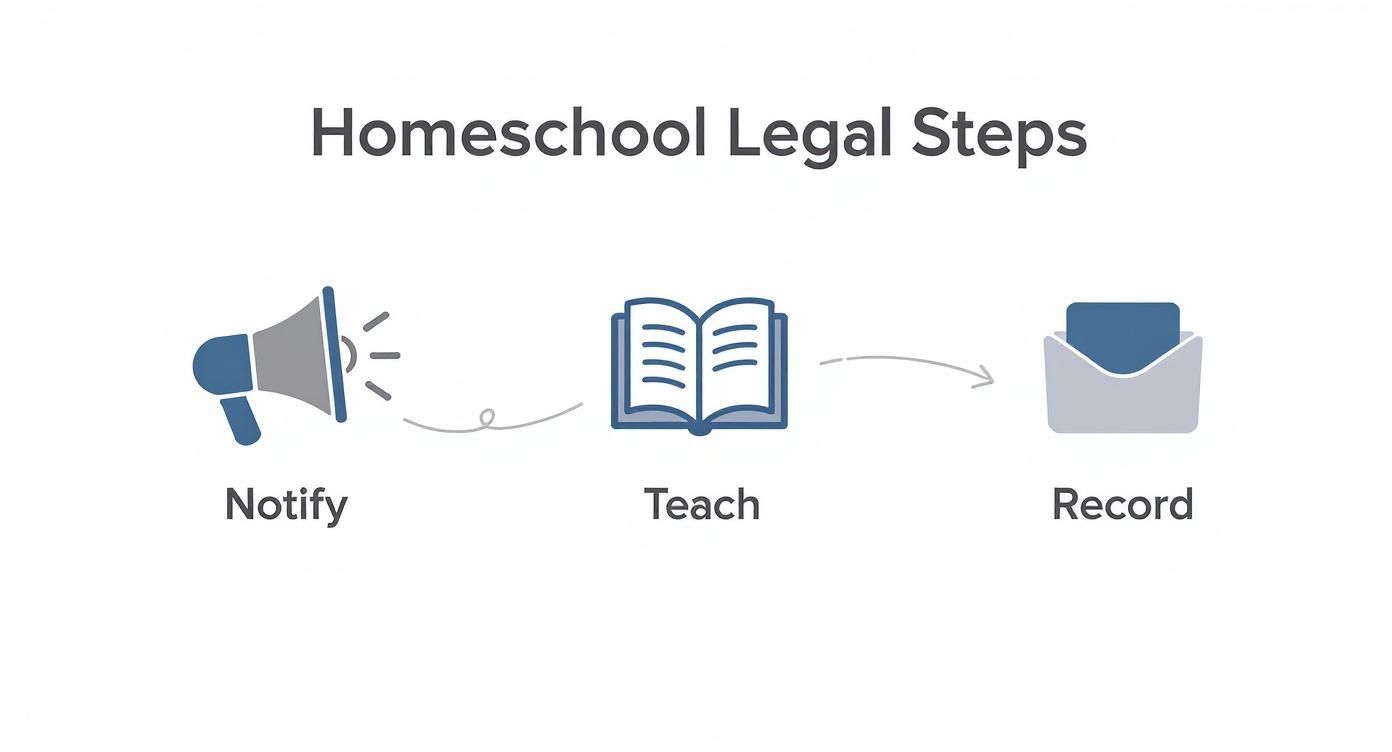
This highlights the fundamental cycle: notify the proper authorities, teach the required subjects, and keep good records. This is the backbone of your yearly planning.
Sample Four-Year High School Plan
To help you visualize how all these pieces can fit together, I've created a sample four-year plan. Please, treat this as a flexible template, not a rigid prescription! You can and should adjust the sequence of courses and the specific electives to align with your teen's academic readiness and future ambitions. This example is geared toward a college-prep track, which is a fantastic starting point for keeping their future options wide open.
| Subject Area | 9th Grade | 10th Grade | 11th Grade | 12th Grade | Total Credits |
|---|---|---|---|---|---|
| English | English 9 (Lit & Comp) | English 10 (World Lit) | American Literature | British Literature | 4 |
| Math | Algebra I | Geometry | Algebra II | Pre-Calculus | 4 |
| Science | Biology with Lab | Chemistry with Lab | Physics | Anatomy & Physiology | 4 |
| History | World History | U.S. History | Government (0.5) / Econ (0.5) | Elective: Modern History | 3.5 |
| Foreign Lang. | Spanish I | Spanish II | 2 | ||
| Fine Arts | Art History & Appreciation | 1 | |||
| Electives | Personal Finance | Public Speaking | Graphic Design | Internship/Work Study | 4.5 |
| Total Credits | 6 Credits | 6 Credits | 6 Credits | 6 Credits | 24 Credits |
As you can see, this plan not only covers the core academic requirements but also leaves plenty of room for electives that build practical life skills and explore potential career paths. This is where you can truly customize the high school journey to prepare your teen for whatever God has planned for them next.
Creating Transcripts and Tracking Credits with Confidence
Let’s talk about the one thing that can make even seasoned homeschool parents break out in a cold sweat: the high school transcript. For so many, it feels like this big, scary, official document that holds the key to their child's future. It seems like the final, most complicated piece of the puzzle.
But I want to pull back the curtain and show you that it's one of the most straightforward administrative tasks you'll handle.
Creating a transcript isn't about jumping through confusing hoops or mastering some secret formula. It's simply about documenting the incredible, customized education you've already worked so hard to provide. Think of it as the polished summary of your teen’s effort, presented in a format that colleges and employers instantly understand. You are absolutely capable of producing a professional document that shines.
What Exactly Is a High School Credit?
First, let’s demystify the high school credit. Most schools and colleges use a standard measurement of time called the Carnegie Unit. It sounds fancy, but it's really just a simple way to track time spent on a subject.
A one-credit course is typically equal to 120-180 hours of focused work over a school year. A half-credit course, logically, is about 60-90 hours.
This gives you a clear and wonderfully flexible benchmark. If your teen spends about an hour a day, five days a week, on math for a standard 36-week school year, they will have logged 180 hours—easily earning one full credit. See? Not so scary.
How to Assign Credits for All Kinds of Learning
Here's where the beauty of homeschooling really comes into play. Learning doesn't just happen in a textbook, and your credits don't have to, either. You have the freedom to assign credit for a huge variety of educational experiences.
-
For Textbook-Based Courses: This is the easiest one. If your student completes a standard high school curriculum like Saxon Math or Apologia Science, you can confidently assign the credit value recommended by the publisher, which is almost always one full credit. Done and done.
-
For Interest-Led or Unit Studies: When learning is more organic and project-based, you'll simply log the hours. Keep a simple log in a notebook or spreadsheet where you jot down the date, the activity, and the time spent. Once you hit that 120-hour mark, you've earned a credit. This works perfectly for deep dives into World War II history or a semester spent learning to code with online tutorials.
-
For Real-World Experiences: Don't forget to count the powerful learning that happens outside the home! An internship, a consistent volunteer role, or even a part-time job can translate directly into elective credits. For example, a student working 10 hours a week at a veterinary clinic could easily earn a credit in "Small Animal Care" by documenting their hours and related learning experiences.
The key to all of this is consistency in your record-keeping. Whether you use a planner, a digital spreadsheet, or a simple spiral notebook, a clear record of hours makes assigning credits an objective and totally defensible process.
Calculating a Grade Point Average (GPA)
Calculating a Grade Point Average (GPA) is another one of those things that sounds more complicated than it is. It’s just a simple numerical snapshot of your student's academic performance. Most transcripts use a standard unweighted 4.0 scale, which is exactly what colleges expect to see.
Here’s the simple breakdown:
- A = 4.0
- B = 3.0
- C = 2.0
- D = 1.0
- F = 0.0
To get the GPA, you just add up the grade points for all their courses and then divide by the total number of credits they earned.
For example, let's say your student took four one-credit courses and earned three A's (4+4+4=12) and one B (3). You would calculate (12 + 3) / 4 = 3.75 GPA.
This clear, standardized system is precisely what college admissions officers are looking for. It proves you've been diligent in tracking your student's progress and are presenting their achievements in a universally accepted format. This level of professional documentation is a big reason behind the high success rates in the homeschooling community. In fact, research shows that the graduation rate for homeschooled students is about 10% higher than for their public school peers, with an impressive 66.7% of them going on to graduate from college. You can explore more homeschooling statistics and see the data for yourself.
By confidently creating transcripts and tracking credits, you’re not just checking a box. You are validating your teen's hard work and paving a clear, credible path for their future success.
Choosing Your Curriculum and Preparing for College
With your four-year plan as a solid roadmap, it's time to choose the educational tools that will bring it to life. Selecting a curriculum can feel like standing in a massive library with thousands of books—the options are endless, and it’s easy to feel overwhelmed.
But here’s the secret: it’s not about finding the one "perfect" curriculum. It's about finding the right fit for your teen’s unique learning style and your family’s educational philosophy. The goal is to match the teaching method to the student, not stuff the student into a restrictive box. This simple shift empowers your teen to take ownership of their learning, turning education from a checklist of tasks into a genuine journey of discovery.
Finding the Right Curriculum Style
The world of homeschool high school curriculum is incredibly diverse. Some families thrive with structured, all-in-one kits that include everything you need right out of the box. Others, like mine, prefer a more eclectic approach, piecing together the best resources from different publishers to create a custom-fit education.
Here are a few popular styles to consider:
- All-in-One Boxed Kits: These are comprehensive packages that provide everything for a full year, often from a single publisher. They offer a clear structure and are fantastic for families who want a straightforward, open-and-go solution.
- Charlotte Mason: This beautiful method emphasizes "living books"—rich, narrative-driven texts—over dry textbooks. It also weaves in nature study, art, music, and narration to create a well-rounded, engaging education.
- Classical Education: This traditional approach focuses on the Trivium (Grammar, Logic, and Rhetoric stages) to teach students how to think critically and communicate effectively. It involves a rigorous study of history, literature, and often Latin.
- Online or Video-Based: For subjects where you might feel less confident, like advanced math or science, online academies and video lessons taught by expert instructors can be a lifesaver.
The key is to remember that curriculum is a tool, not a master. You have the freedom to adapt, supplement, or even switch resources mid-year if something isn't working. Your primary role is to facilitate learning, not to be an expert in every single subject.
If you're exploring different options, you might be interested in our reviews and insights on various homeschool curriculum choices.
Pivoting Toward College Preparation
As you move through the high school years, your focus will naturally start shifting toward what comes next. This is where you begin strategically building a record that showcases your teen’s academic strengths and readiness for higher education.
One of the most powerful tools in your arsenal is the ability to write compelling course descriptions. A course description is just a brief paragraph that goes beyond a simple title on the transcript. It details what was studied, the materials used (textbooks, literature), and the skills mastered. This small step adds immense credibility and helps college admissions officers understand the depth and rigor of your homeschool.
Standardized tests are another key piece of the college prep puzzle. Tests like the SAT or ACT are often a big part of the admissions process. Learning how to study for SAT Math effectively, for example, can make a huge difference in your teen's scores and college options.
The Game-Changer of Dual Enrollment
Perhaps one of the most effective strategies for preparing a homeschooled student for college is dual enrollment. This allows your teen to take actual college classes at a local community college while still technically in high school. The benefits are enormous.
First, your student earns both high school and college credit at the same time, giving them a significant head start. Second, it provides a gentle transition into the college environment, letting them experience the pace and expectations of higher education in a supportive context.
Finally, and most importantly, it creates an official college transcript from an accredited institution. This provides powerful, third-party validation of your teen’s academic abilities, which can be a huge advantage in competitive admissions.
This trend of seeking robust educational options is not just a local phenomenon. Homeschooling at the high school level has seen remarkable growth globally. In Australia, the number of registered homeschoolers shot up from 21,437 in 2019 to 45,858 in 2024. Similarly, in the United Kingdom, the number rose from 86,000 in 2022 to 97,000 in 2023—that's a 12.8% increase in just one year.
By choosing the right curriculum and taking proactive steps toward college prep, you're not just educating your child; you're part of a growing, successful educational movement.
Building a Strong Portfolio and Extracurriculars

A high school transcript shows the grades, but a portfolio tells the story. It’s where your teen’s projects, passions, and unique growth come to life in a way that numbers on a page simply can’t.
Think of it like a personal art gallery. Each piece—a research paper, a science experiment, a piece of art—showcases their skills, interests, and real-world learning. This collection becomes powerful proof of their journey, preparing them for college applications and career opportunities.
Building a homeschool portfolio is all about gathering meaningful work that demonstrates depth, not just checking off boxes.
Key pieces to include are:
- Project Descriptions that explain what they did and what they learned.
- Reflective Journals where they can analyze their own learning process.
- Visual Summaries like infographics or photo essays to make their work pop.
Homeschooling surveys have found that a compelling portfolio can boost a student’s confidence by as much as 40%. It’s tangible proof of their hard work!
Once you have the academic side covered, it’s time to shine a light on extracurriculars. These activities are your answer to the old "what about socialization?" question, proving that homeschooled teens are deeply engaged in their communities.
- Competitive Sports build teamwork, discipline, and resilience.
- Robotics Clubs showcase creative problem-solving and technical skills.
- Community Service demonstrates leadership, empathy, and a heart for others.
Developing a Portfolio Structure
A little organization goes a long way. You can structure the portfolio by theme (like grouping all the STEM projects together) or simply in chronological order. Create distinct sections for arts, volunteer work, or even entrepreneurial ventures, like that Etsy shop they started.
Next, think about going digital. A simple website or online portfolio is incredibly easy to share with college admissions officers or potential employers. It’s like having a personal mini-exhibit ready to go at a moment's notice.
Choosing Extracurriculars That Shine
Extracurriculars are so much more than just resumé-fillers. They are where soft skills—communication, time management, and innovation—are developed and proven. Encourage your teen to explore different roles and activities, committing to each for at least a semester.
- Join a homeschool co-op for group classes and collaborative projects. Read our guide to learn more about homeschool co-ops.
- Volunteer regularly at a local charity to build a record of civic engagement.
- Launch a passion project, like starting a blog or a podcast, that aligns with their unique interests.
“My portfolio opened doors at my dream college,” one of our homeschooled grads shared with me. It’s that real-world proof that makes all the difference.
Here’s a quick way to think about how activities translate into skills:
| Activity Type | Skill Highlighted | Example Outcome |
|---|---|---|
| Robotics Club | Engineering design | Regional competition award |
| Volunteer Service | Leadership | Community recognition |
| Fine Art Portfolio | Creativity | Local gallery showcase |
By combining a thoughtfully organized portfolio with meaningful extracurriculars, you paint a much richer picture than a transcript ever could. This approach empowers your teen to stand out and confidently share the unique story of their education.
Make it a habit to update the portfolio every year, and be sure to involve your teen in curating their best work. This turns documentation from a chore into a tool for growth.
It’s a process, but one that truly celebrates their journey.
Wrapping Up: Your Final Homeschool High School Questions Answered
By now, you’ve learned how to navigate the legal side of things, map out a four-year plan, and build those all-important official records. Still, I know from experience that a few nagging questions might be bouncing around in your head. It’s completely normal.
This final section is all about tackling those common worries head-on. Let’s get these last few concerns ironed out so you can step into this journey with the confidence you and your teen deserve.
Can My Teen Really Get Into a Good College?
Yes, absolutely. In fact, not only can they get in, but many colleges actively recruit homeschooled students. Why? Because admissions officers know that homeschoolers often bring a unique level of independence, self-motivation, and a genuine love for learning that stands out.
The key is simply to present your teen professionally. All the tools we’ve already talked about—a polished transcript, solid standardized test scores, and a compelling portfolio with detailed course descriptions—are what make the difference. With those pieces in place, your student won't just be another applicant; they'll be a competitive one, even at top-tier universities.
How Do I Actually Issue a High School Diploma?
This one is simpler than it sounds. As the administrator of your homeschool, you hold the legal authority to issue a diploma once your student has met your state's graduation requirements. It helps to think of yourself as the principal of your own private school—because, in a legal sense, that's exactly what you are!
You can easily order a professional-looking diploma online from a variety of vendors. More importantly, this is a moment to celebrate! Plan a graduation party, hold a small ceremony with friends and family, or find another special way to honor all the incredible hard work and achievement. It's a huge milestone.
One of the biggest myths out there is that homeschooled kids are somehow socially awkward. The reality I've seen over and over is that homeschooled teens often develop exceptional social skills. They learn to interact naturally with people of all ages through co-ops, sports, volunteer work, and part-time jobs—not just a single, narrow peer group. This kind of real-world socialization builds far more diverse and mature communication skills.
Am I Qualified to Teach Advanced High School Subjects?
Let me put your mind at ease: you don’t have to be an expert in everything. As your kids hit the high school years, your role naturally shifts from being the sole teacher to being a facilitator of learning. You're the guide, the resource-finder, the academic coach—not the ultimate source of all knowledge.
When it comes to advanced subjects like Chemistry, Physics, or Pre-Calculus, you have an incredible wealth of resources at your fingertips. You are not alone on a deserted island!
- Video Curricula: Find amazing programs taught by actual expert instructors.
- Online Classes: Enroll your teen in live or self-paced online courses with subject matter specialists.
- Local Co-ops: Join group classes taught by other parents who have expertise in a specific area or by hired tutors.
- Dual Enrollment: Let them take challenging classes and earn college credit by learning directly from college professors.
This approach gives your student access to specialized instruction while you continue to oversee and guide their overall educational journey. It’s truly the best of both worlds.
At The Mom Resource, our entire mission is to give you the tools and encouragement you need to teach with confidence. If you need more, explore our huge library of resources and join a community that truly gets it. You can find everything you need at https://themomresource.com.