
homeschool schedule ideas: 10 routines for busy families
The beauty of homeschooling lies in its flexibility, but that freedom can also feel overwhelming. How do you structure your day for learning without recreating public school at your kitchen table? The key isn't finding one "perfect" schedule but discovering the right framework for your family's unique needs, ages, and educational philosophy. This guide moves beyond generic templates to explore 10 distinct and actionable homeschool schedule ideas.
From the literature-rich cadence of a Charlotte Mason day to the interest-led freedom of unschooling, we'll provide detailed sample schedules and practical implementation tips. We will cover the pros and cons of each approach to help you make an informed choice. This collection is designed to give you a clear starting point, whether you are teaching multiple children at different grade levels, looking to integrate your faith into daily lessons, or building a routine for the very first time.
The goal is to move past the pressure of a rigid timetable and instead build a sustainable rhythm that serves your family’s goals. You'll find concrete examples for toddlers, elementary students, and middle schoolers, alongside methods like block scheduling, loop scheduling, and year-round seasonal learning. Ultimately, finding your family's perfect rhythm means discovering effective strategies to make learning fun, fostering intrinsic motivation and lasting results beyond conventional methods. This list will equip you to create a joyful and effective learning environment that truly fits your home.
1. Classical/Charlotte Mason Schedule
The Classical/Charlotte Mason homeschool schedule is a structured yet enriching approach that blends rigorous classical education with the gentle, holistic philosophy of educator Charlotte Mason. This model emphasizes short, focused lessons, a wide variety of subjects, and the use of "living books" instead of dry textbooks. The goal is to cultivate a love of learning, develop strong moral character, and expose children to the best of human thought and creativity.

A typical day runs about four to five hours and is filled with brief, varied lessons, often lasting just 20-30 minutes for elementary-aged students. This method respects a child’s natural attention span, keeping them engaged and preventing burnout. The schedule intentionally weaves together academic subjects like math and grammar with enriching activities like nature study, art, music appreciation, and handicrafts.
Who Should Use This Schedule?
This approach is one of the most popular homeschool schedule ideas for families who value a well-rounded, literature-rich education. It works exceptionally well if you want to:
- Avoid burnout: Short lessons keep learning fresh and exciting.
- Cultivate a love for reading: "Living books" written by passionate authors bring subjects to life.
- Educate the whole child: The schedule balances intellectual, artistic, and practical skills.
- Establish a consistent routine: The predictable structure helps children thrive.
How to Implement It
To successfully adopt this schedule, focus on structure and quality resources. Start by organizing your morning with the most demanding academic subjects first, when concentration is highest. Transition to lighter, more hands-on activities in the afternoon.
Actionable Tips:
- Use a Timer: Strictly adhere to short lesson blocks to maintain focus and momentum.
- Post a Visual Schedule: Display the daily routine where your children can see it, promoting independence.
- Incorporate Nature Study: Dedicate at least one afternoon per week to exploring the outdoors, sketching, and journaling observations.
- Build a Family Library: Prioritize beautifully written and illustrated living books over traditional textbooks. For a deeper look into this philosophy, you can learn more about implementing the Charlotte Mason method in your homeschool on themomresource.com.
2. Unit Study/Thematic Schedule
The Unit Study/Thematic homeschool schedule is an immersive, integrated approach where multiple subjects revolve around a single, central theme. Instead of studying history, science, and art as separate subjects, students explore them through the lens of one comprehensive topic, such as Ancient Egypt, the ocean, or the solar system, for a period of one to twelve weeks. This method fosters a deeper understanding by helping children see the natural connections between different fields of knowledge.

A day in a unit study schedule is fluid and project-based. The morning might be dedicated to reading a historical novel set during the unit's time period, while the afternoon could involve a science experiment, an art project, or even a cooking activity related to the theme. This model moves away from a rigid, compartmentalized timetable and toward a more holistic and engaging learning experience, making it one of the most dynamic homeschool schedule ideas available.
Who Should Use This Schedule?
This approach is ideal for families who want to make learning meaningful and interconnected. It is particularly effective if you want to:
- Deepen understanding: Connecting subjects around a theme reinforces learning and improves retention.
- Engage student interests: Units can be tailored to a child's passions, sparking curiosity and motivation.
- Teach multiple ages together: Siblings of different ages can study the same topic at their own level.
- Encourage project-based learning: It provides ample opportunities for hands-on activities, research, and creative expression.
How to Implement It
Successful unit studies require thoughtful planning but offer immense flexibility. Start by choosing a broad topic that genuinely interests your child. Then, brainstorm how various subjects like literature, history, science, and math can connect to it. Curricula like Beautiful Feet Books offer literature-rich unit studies that can provide a great starting point.
Actionable Tips:
- Create a Web Diagram: Visually map out how each school subject connects to your central theme before you begin.
- Plan One Unit at a Time: Avoid feeling overwhelmed by focusing your planning efforts on the current unit only.
- Use the Library: Supplement your studies with a wide range of books, documentaries, and resources from your local library.
- Allow for Student Choice: Let your child choose at least one project or area of focus within the unit to foster ownership of their learning.
3. Classical Trivium Schedule
The Classical Trivium schedule is a highly structured, time-tested approach that organizes education according to a child's natural cognitive development. This model is built on the "trivium," which consists of three distinct stages: Grammar (K-6), Logic (7-9), and Rhetoric (10-12). Each stage focuses on developing specific skills, from memorizing foundational facts to mastering persuasive expression.
This schedule is rigorous and content-rich, emphasizing history as its organizational backbone and integrating subjects like literature, writing, and philosophy. The Grammar stage is heavy on memory work, such as timelines, Latin roots, and math facts. The Logic stage shifts to analysis and critical thinking, while the Rhetoric stage culminates in developing articulate, eloquent communication skills. It's a systematic progression designed to create a well-rounded, logical, and expressive thinker.
Who Should Use This Schedule?
This is one of the most robust homeschool schedule ideas for families seeking a deep, historically grounded, and academically challenging education. It is particularly well-suited for parents who want to:
- Align learning with developmental stages: The schedule naturally adapts to a child’s changing ability to absorb, analyze, and articulate information.
- Build a strong foundation of knowledge: The emphasis on memory work in the early years creates a vast mental library of facts.
- Develop strong critical thinking skills: Students are trained not just to know things, but to reason, argue, and analyze them effectively.
- Integrate subjects for a cohesive worldview: History provides the chronological framework that connects all other areas of study.
How to Implement It
Successfully implementing a Classical Trivium schedule requires long-term vision and consistency. Begin by identifying which stage your child is in and select curricula, such as The Well-Trained Mind or Veritas Press, that aligns with that stage's goals. Your daily schedule should reflect the stage’s focus; for example, a Grammar stage schedule will include lots of chants, songs, and recitation.
Actionable Tips:
- Use Timelines Extensively: A visual timeline is a core tool for connecting historical events, scientific discoveries, and literature across subjects.
- Focus on Memory Work: In the Grammar stage, dedicate daily time to memorizing key facts using songs, chants, and flashcards.
- Incorporate Formal Logic: Once in the Logic stage, introduce formal logic studies to teach the mechanics of sound arguments.
- Practice Debate and Rhetoric: For high schoolers, create opportunities for formal debate and persuasive writing to hone their Rhetoric skills.
4. Unschooling/Child-Led Schedule
The Unschooling/Child-Led approach is less of a schedule and more of a philosophy where education emerges organically from a child's natural curiosity and daily life experiences. Popularized by thinkers like John Holt, this model operates on the principle that children are born learners. Instead of a predefined curriculum, learning happens through play, exploration, real-world activities, and pursuing individual interests.
In this model, the parent's role shifts from teacher to facilitator. The goal is to create a rich, stimulating environment filled with resources like books, art supplies, tools, and access to the community. There is no set timetable for subjects; a question about a bug in the garden could lead to a deep dive into entomology, or baking a cake could become a hands-on lesson in chemistry and fractions. The day unfolds based on what captures the child's interest.
Who Should Use This Schedule?
This is one of the most liberating homeschool schedule ideas for families who trust their child's innate ability to learn and want to move completely away from the traditional school model. It's an excellent fit if you want to:
- Foster intrinsic motivation: Children learn because they are genuinely interested, not because they are told to.
- Encourage deep, meaningful learning: Interest-led deep dives create lasting knowledge and skills.
- Strengthen family connections: Learning together through shared experiences builds strong bonds.
- Prepare children for real-life problem-solving: This approach mirrors how adults learn and adapt in the real world.
How to Implement It
Successfully implementing unschooling requires a significant mindset shift from traditional education. It's about trusting the process and providing support rather than direction. Start by observing your child's interests and strewing resources that align with them.
Actionable Tips:
- Create a Rich Environment: Make your home a place of discovery with easy access to books, games, art materials, and technology.
- Keep a Learning Log: Document the organic learning that happens each day. This can be helpful for your own peace of mind and for meeting state requirements. For those in specific states, you can learn more about how to unschool while meeting legal standards on themomresource.com.
- Model Curiosity: Be a lifelong learner yourself. Share your own passions, ask questions, and explore new hobbies alongside your children.
- Trust the Process: Learning may look messy and non-linear compared to school. Trust that your child is learning what they need, when they need it.
5. Block Scheduling/Rotating Schedule
Block scheduling, also known as a rotating schedule, offers a dynamic way to organize your homeschool week by focusing on specific subjects for dedicated periods rather than touching on every topic daily. This approach involves grouping subjects into "blocks" that rotate on a daily, weekly, or even seasonal basis. Instead of juggling six subjects every day, you might focus deeply on just two or three, reducing mental clutter and allowing for more immersive learning experiences.
This method is incredibly flexible. A daily rotation could mean tackling math and language arts on odd-numbered days, while science and history are studied on even-numbered days. A weekly model might dedicate entire days to specific themes, like "History Tuesday" or "Science Thursday," while a seasonal approach could involve an intensive study of botany in the spring and ancient history in the fall. The core principle is depth over breadth in any given day.
Who Should Use This Schedule?
This is one of the best homeschool schedule ideas for families who find the daily grind of covering every subject overwhelming. It is particularly effective if you want to:
- Reduce daily transitions: Fewer subjects per day mean less time switching gears and more focused learning.
- Accommodate deep dives: It allows for longer, project-based learning sessions that a traditional schedule can't fit.
- Keep learning fresh: The rotating nature of the schedule prevents monotony and keeps children engaged.
- Align with co-ops or activities: Block out days for outside classes, field trips, or extracurriculars without disrupting core learning.
How to Implement It
Successful block scheduling relies on clear planning and communication. A visual calendar or chart is essential so everyone knows what to expect each day. While some subjects rotate, it's often wise to keep core skills like math and reading as a daily constant, especially for younger learners who need consistent practice.
Actionable Tips:
- Create a Visual Calendar: Use a color-coded chart to display the rotating schedule for the week or month.
- Keep Core Skills Daily: Consider a daily "power hour" for non-negotiable subjects like math and phonics before moving to the day's block.
- Plan Seasonal Blocks: Align your science and nature studies with the seasons, such as studying marine biology in the summer or astronomy in the winter.
- Build in Review Time: When a subject is "off-block," schedule brief review sessions to ensure retention. For example, use flashcards or a quick game to review history facts during a science-focused week.
6. Multiple Levels/Loop Schedule
The Multiple Levels/Loop Schedule is a lifesaver for families homeschooling children of different ages and grade levels. Instead of assigning subjects to specific days, a loop schedule features a list of subjects that you rotate through sequentially. When you finish one, you simply move to the next on the list, picking up where you left off the following day. This approach removes the pressure of a rigid timetable, ensuring all subjects are covered over time without the guilt of falling behind.
This model is designed for flexibility. For example, if history, science, art, and music are on your loop, you might complete history and science on Monday. On Tuesday, you would start with art, then music, and loop back to history. This method allows you to accommodate interruptions, varying energy levels, and the different learning paces of multiple children seamlessly.
Who Should Use This Schedule?
This is one of the most practical homeschool schedule ideas for large families or anyone teaching multiple grade levels. It is particularly effective if you want to:
- Reduce scheduling stress: Eliminate the pressure of a "never-ending to-do list."
- Combine subjects: Easily teach subjects like history or science to multiple ages together.
- Ensure variety: Cover enrichment subjects consistently without having to fit them into a crowded daily schedule.
- Accommodate life's interruptions: A sick day or an unexpected appointment won't derail your entire week.
How to Implement It
Successful implementation relies on creating a manageable loop and combining it with a few daily non-negotiables. Start by listing the subjects you want to include in your loop, such as art, music appreciation, nature study, geography, and composer study. Keep core subjects like math and language arts as daily requirements outside the loop.
Actionable Tips:
- Keep Loops Short: Limit your loop to 5-8 subjects to prevent it from becoming too long and ensure you cycle through it regularly.
- Use Visual Trackers: Print a weekly tracking sheet or use a simple checklist to monitor which subjects you have completed.
- Color-Code for Clarity: Assign a different color to each child's independent tasks within a shared family loop.
- Reset Weekly: To avoid letting the loop run on indefinitely, consider resetting it every Monday to ensure a fresh start and consistent coverage. You can find excellent free loop schedule templates on Donna Young's website.
7. 4-Day School Week Schedule
The 4-day school week schedule is a popular and efficient model that condenses formal academic instruction into four days, typically Monday through Thursday. This approach frees up the fifth day for enrichment activities, field trips, co-op classes, appointments, or simply a day of rest and unstructured learning. It provides a powerful combination of structure and flexibility, allowing families to complete core lessons efficiently while reserving a full day for other valuable experiences.
This schedule works by slightly extending the learning time on the four "school" days to cover all necessary material. The "off" day isn't truly a day off from learning but a shift in focus. It becomes a dedicated time for practical life skills, deep dives into passion projects, community involvement, or nature exploration, enriching the standard curriculum in ways a traditional five-day structure might not allow.
Who Should Use This Schedule?
This is one of the most practical homeschool schedule ideas for families seeking a better work-life-school balance. It is an excellent fit if you want to:
- Create margin in your week: Freeing up a weekday is ideal for errands, appointments, and household management.
- Participate in co-ops: Many homeschool co-ops meet on Fridays, making this schedule a perfect match.
- Facilitate deep learning: The fifth day can be used for elaborate science experiments, art projects, or field trips that don't fit into a standard school day.
- Reduce burnout: A three-day weekend can be restorative for both parents and children, keeping everyone motivated.
How to Implement It
Success with a 4-day schedule hinges on focused effort during the four instructional days and intentional planning for the fifth. You'll need to be disciplined from Monday to Thursday to ensure all core subjects are covered, making the flexible Friday a well-earned reward.
Actionable Tips:
- Plan Your Flex Day: Decide how you will use Fridays during your weekly planning session. Will it be for nature study, a museum visit, volunteering, or life skills?
- Maintain a Consistent Core Routine: Stick to a predictable schedule from Monday to Thursday to ensure academic progress isn't compromised.
- Use Fridays for Catch-Up: Designate a small portion of Friday for any assignments that weren't completed during the week, preventing work from spilling into the weekend.
- Protect Your Day Off: Be firm about not letting formal lessons creep into your fifth day; its value lies in being different from the rest of the week.
8. Eclectic/Mix & Match Schedule
The Eclectic, or Mix & Match, homeschool schedule is a highly personalized approach that cherry-picks the best elements from various homeschooling philosophies and curricula. Instead of adhering strictly to one method, eclectic homeschoolers create a unique educational tapestry tailored to their children's specific learning styles, interests, and their family’s core values. This method empowers parents to become curriculum designers, blending resources to create a truly bespoke learning experience.
A day in an eclectic homeschool might start with a structured math curriculum like Saxon, followed by a literature-rich history lesson using "living books" from a Charlotte Mason approach, and end with a hands-on Montessori-inspired science project. The schedule is defined by its flexibility and its focus on what works for the individual child, rather than forcing a child to fit a predetermined system. It’s one of the most adaptable homeschool schedule ideas available.
Who Should Use This Schedule?
This approach is ideal for experienced homeschoolers who are confident in their educational goals and familiar with different methods. It is also a great fit for families who:
- Have children with diverse learning styles: You can choose different resources for different subjects or different children.
- Want to customize their curriculum: You can pull the best parts of multiple programs to meet specific needs.
- Prefer freedom and flexibility: This schedule adapts to your family’s evolving needs and interests.
- Are on a budget: It allows you to utilize free resources, library books, and select curriculum pieces without buying entire boxed sets.
How to Implement It
Successfully implementing an eclectic schedule requires research and a clear vision. Start by defining your family's educational philosophy and goals, then explore different methods to find components that align with them. A common strategy is to choose a "spine" curriculum for core subjects like math or language arts and supplement with other resources.
Actionable Tips:
- Start with Your Values: Identify your non-negotiables first. Is it hands-on learning? A strong literature focus? Faith integration? Let that guide your choices.
- Choose a "Backbone" Curriculum: Select a solid, reliable program for one or two core subjects to provide structure and prevent feeling overwhelmed.
- Supplement Strategically: Add other resources, like unit studies, documentaries, or online classes, to enrich the core curriculum, not replace it.
- Review and Adjust Quarterly: Regularly assess what’s working and what isn’t. Don’t be afraid to shelve a resource that isn't a good fit, even if you paid for it. As curriculum reviewer Cathy Duffy often highlights, the goal is to find the best fit for your child.
9. Time-Blocking/Time-Boxing Schedule
The Time-Blocking or Time-Boxing homeschool schedule is a highly structured method focused on efficient time management. With this approach, you dedicate specific, fixed blocks of time to individual subjects or tasks, such as "9:00-9:45 AM: Math." The primary goal is to maintain focus for a set duration and move on when the timer goes off, rather than working until a task is fully completed. This teaches children powerful time management and concentration skills.
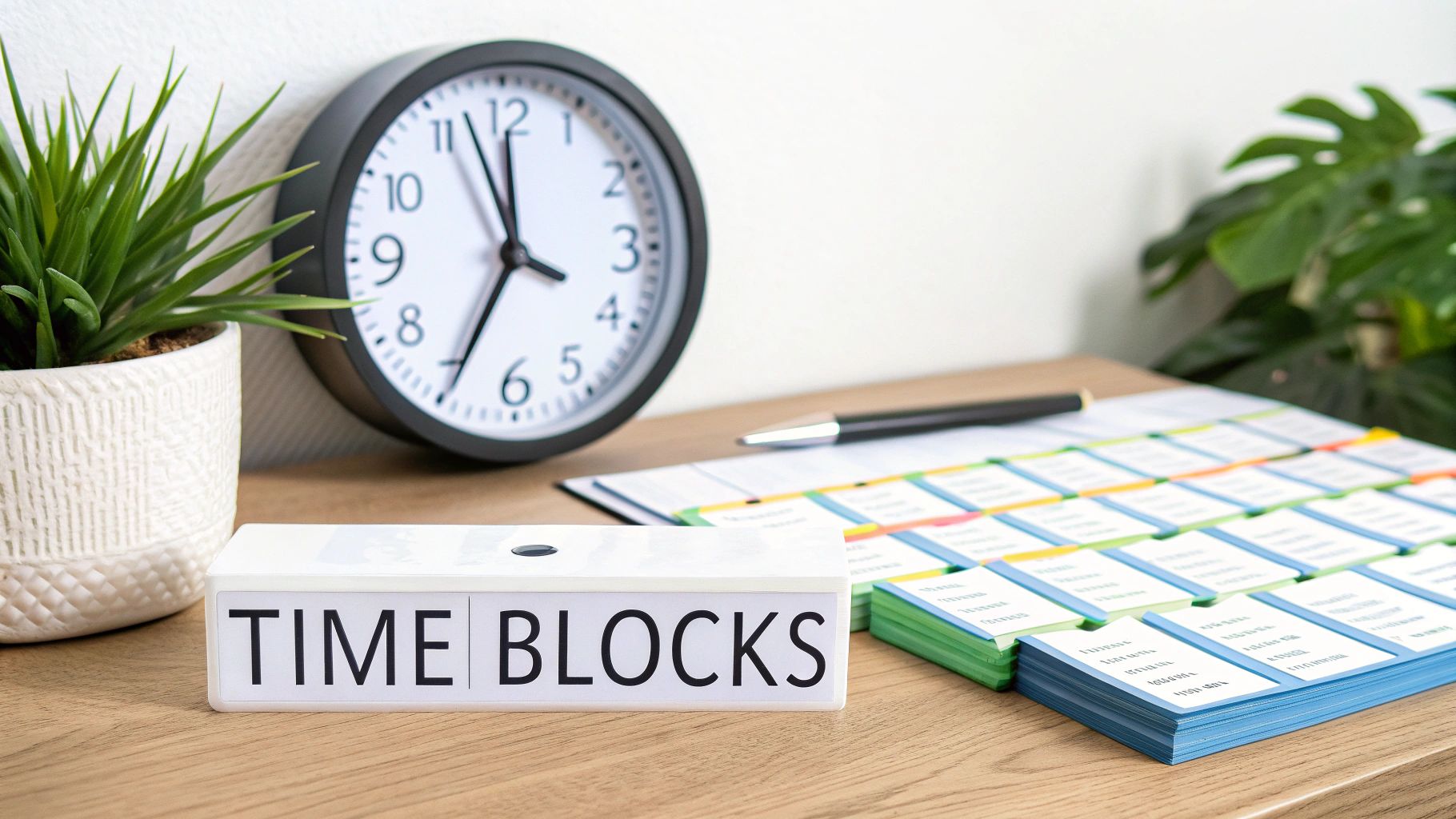
This method mirrors the structure of a traditional school day or a corporate time-management system, adapted for a home environment. The emphasis is on the process and consistent effort, which can reduce the pressure to "finish" everything. It's an excellent way to cover multiple subjects daily without feeling overwhelmed and helps children understand that time is a finite resource to be used wisely.
Who Should Use This Schedule?
This is one of the most effective homeschool schedule ideas for families who need a clear, predictable structure to stay on track. It is particularly beneficial if you want to:
- Boost productivity and focus: Defined time limits encourage deep work.
- Prevent dawdling: A ticking clock motivates children to stay on task.
- Cover all subjects consistently: Each subject is guaranteed a dedicated time slot.
- Manage multiple children or a work-from-home career: The rigid structure creates predictable pockets of time for different needs.
How to Implement It
Successful implementation relies on discipline and a visual framework. Start by scheduling the most intensive subjects during your child's peak focus hours, which for many is the morning. Be firm with your time blocks, but also build in flexibility where needed. It is a system that can be incredibly helpful for parents who need to learn more about how to balance working from home and homeschooling on themomresource.com.
Actionable Tips:
- Use a Visual Timer: A physical or digital timer helps children see how much time is left, making transitions easier.
- Post the Schedule: Keep the daily time-blocked schedule in a highly visible area like the refrigerator or a whiteboard.
- Build in Buffers: Add 5-minute transition periods between blocks to allow for breaks, cleanup, or switching materials.
- Accept Incompletion: Teach your child (and yourself) that it's okay if an assignment isn't finished when time is up. It can be revisited later or in a designated overflow block.
10. Seasonal/Rhythm Schedule
The Seasonal or Rhythm Schedule is a holistic approach that aligns learning with the natural cycles of the year. Inspired by Waldorf education principles and homesteading lifestyles, this model uses the changing seasons as a framework for academic subjects, creative activities, and family routines. Instead of a rigid daily timetable, the focus is on a gentle, predictable rhythm that adapts to outdoor opportunities, holidays, and the flow of family life.
This schedule ebbs and flows, with different learning priorities for each season. For instance, autumn might involve a deeper focus on core academics, while winter is a time for cozy indoor handicrafts and storytelling. Spring naturally lends itself to biology and gardening, and summer is ideal for relaxed project-based learning, travel, or skill-building. The goal is to create a harmonious learning environment that feels connected to the world around you.
Who Should Use This Schedule?
This is one of the best homeschool schedule ideas for families who want to embrace a more natural, unhurried pace of learning. It is an excellent fit if you want to:
- Connect learning to nature: Make the natural world a central part of your curriculum.
- Reduce scheduling pressure: Follow a rhythm rather than a strict, clock-based schedule.
- Embrace hands-on learning: Integrate practical skills like cooking, gardening, and crafting.
- Honor family traditions: Easily incorporate seasonal holidays and celebrations into your homeschool.
How to Implement It
To adopt this schedule, begin by broadly planning your year in seasonal blocks. Think about the energy and opportunities unique to fall, winter, spring, and summer. Map out major themes, projects, or unit studies for each season, allowing the daily rhythm to remain flexible within that larger structure.
Actionable Tips:
- Plan in Seasonal Blocks: Designate autumn for a heavier academic push, winter for cozy indoor projects, spring for nature exploration, and summer for more relaxed, interest-led learning.
- Use Nature as a Guide: Base science lessons on local seasonal changes. Study plant life cycles in the spring and animal hibernation in the fall.
- Incorporate Seasonal Crafts: Weave in activities like leaf pressing, wreath making, knitting, or planting seeds based on the time of year.
- Create a Rhythm Chart: Instead of a timed schedule, display a visual flow of the day (e.g., Morning Chores > Table Time > Outdoor Play > Lunch > Quiet Time) to create predictability. For more inspiration, Waldorf-inspired resources from sites like The BEarth Institute can provide a deeper understanding of building these rhythms.
Comparison of 10 Homeschool Schedules
| Schedule | Implementation Complexity 🔄 | Resource Requirements 💡 | Expected Outcomes ⭐📊 | Ideal Use Cases ⚡ | Key Advantages |
|---|---|---|---|---|---|
| Classical / Charlotte Mason Schedule | High — detailed planning and prep 🔄 | Moderate–High — living books, nature time, parent prep 💡 | ⭐⭐⭐⭐ — strong literacy, habit formation; slower scope 📊 | Literature-focused, mixed-age homeschools, habit-building ⚡ | Deep reading comprehension, low burnout, consistent routine |
| Unit Study / Thematic Schedule | Medium–High — unit design and integration 🔄 | Moderate — themed resources, project materials 💡 | ⭐⭐⭐⭐ — high engagement, cross-curricular connections 📊 | Interest-led learning, family projects, multi-age groups ⚡ | Engaging, promotes critical thinking and transfer of learning |
| Classical Trivium Schedule | High — requires stage-aligned curriculum knowledge 🔄 | Moderate — classical texts, memory work, co-op support 💡 | ⭐⭐⭐⭐ — clear progression, strong reasoning and rhetoric 📊 | Families seeking classical education and academic rigor ⚡ | Developmental alignment, structured benchmarks, strong writing prep |
| Unschooling / Child-Led Schedule | Medium — low formal structure but high facilitation skill 🔄 | Moderate — rich environment, community/resources access 💡 | ⭐⭐⭐ — high motivation and independence; potential skill gaps 📊 | Self-motivated learners, flexible lifestyles, travel families ⚡ | High autonomy, intrinsic motivation, adaptable to life |
| Block Scheduling / Rotating Schedule | Medium — plan rotations and calendars 🔄 | Low–Moderate — calendar planning, occasional resources 💡 | ⭐⭐⭐⭐ — deep focus and immersion; uneven daily practice for some skills 📊 | Subjects needing immersion, multi-child management, field trips ⚡ | Reduced context-switching, easier group management, immersion time |
| Multiple Levels / Loop Schedule | Medium — create and monitor loops 🔄 | Low–Moderate — tracking sheets, simple resources 💡 | ⭐⭐⭐ — flexible coverage with natural review; inconsistent daily practice 📊 | Large families, wide age gaps, unpredictable days ⚡ | Extremely forgiving, minimizes daily pressure, built-in repetition |
| 4-Day School Week Schedule | Low–Medium — compress and plan flex day 🔄 | Moderate — longer teaching blocks, planning for enrichment day 💡 | ⭐⭐⭐ — maintains routine with extra enrichment; longer days 📊 | Families wanting dedicated enrichment/field-trip day, co-ops ⚡ | Built-in enrichment/flex day, easier scheduling for activities |
| Eclectic / Mix & Match Schedule | High — ongoing curation and adjustment 🔄 | Moderate–High — varied curricula and supplements 💡 | ⭐⭐⭐⭐ — highly personalized outcomes; coherence varies 📊 | Experienced homeschoolers, families needing personalization ⚡ | Customizable, flexible, can pick best resources for needs |
| Time-Blocking / Time-Boxing Schedule | Medium — strict timing and adherence 🔄 | Low — timers, visible schedule, minimal materials 💡 | ⭐⭐⭐⭐ — strong time management and predictability; may rush depth 📊 | Students needing structure, working parents, routines ⚡ | Teaches discipline, reduces perfectionism, easy progress tracking |
| Seasonal / Rhythm Schedule | Medium — seasonal planning and adaptation 🔄 | Moderate — outdoor access, seasonal materials, planning 💡 | ⭐⭐⭐⭐ — strong nature connection and engagement; variable continuity 📊 | Nature-focused families, outdoor climates, Waldorf-influenced homes ⚡ | Aligns with natural cycles, high engagement, flexible pacing |
Crafting Your Schedule: Grace, Flexibility, and Next Steps
The journey through these ten distinct homeschool schedule ideas, from the structured rhythms of a Classical approach to the fluid, interest-led days of Unschooling, reveals a powerful truth: there is no single "perfect" homeschool schedule. Instead, the ideal framework is the one that brings peace, purpose, and a love for learning into your unique home. It’s a dynamic tool, not a rigid set of rules, designed to serve your family’s evolving needs, educational philosophies, and spiritual goals.
Think of these schedules not as prescriptive blueprints but as a rich palette of colors. You are the artist, free to blend different elements to create a masterpiece that works for your family. Perhaps the structure of Time-Blocking is perfect for core subjects like math and language arts, but a Loop Schedule feels more freeing for history, science, and art. You might find that a Four-Day School Week provides the margin your family needs for co-ops and extracurriculars, while incorporating a Seasonal Rhythm keeps learning fresh and connected to the world outside your window.
Key Takeaways for Building Your Framework
The most important lesson is that a schedule is a servant, not a master. Its purpose is to reduce decision fatigue, create a predictable and secure environment for your children, and ensure you are making progress toward your goals. As you move forward, keep these core principles at the forefront of your planning:
- Embrace Evolution: The schedule that works wonders for your family with a kindergartener and a toddler will inevitably need adjustments when you have a third-grader and a middle-schooler. Be prepared to reassess your rhythm quarterly or even monthly. Ask what’s working and what’s causing friction, and don’t be afraid to make changes.
- Prioritize Connection: Your homeschool schedule should create opportunities for connection, not eliminate them. If a rigid timeline is causing stress and tears, it’s not serving its purpose. Build in time for read-alouds, nature walks, and spontaneous conversations. These moments are often where the most profound learning happens.
- Integrate Grace: There will be sick days, difficult toddler phases, and unexpected interruptions. A successful homeschool is not one where the schedule is followed perfectly every day. It's one where grace abounds, and you can confidently set the plans aside to tend to the more important needs of your family, knowing the structure will be there to welcome you back.
Your Actionable Next Steps
Feeling inspired but a bit overwhelmed by the possibilities? Let's break down how to move from inspiration to implementation. Here is a simple, three-step process to get started:
- Define Your Non-Negotiables: Before you even pick a schedule type, list your family’s core priorities. This might include daily Bible study, outdoor time, independent reading, and specific chore responsibilities. These are the foundational pillars around which your schedule will be built.
- Select and Sketch a Hybrid Model: Choose two or three of the homeschool schedule ideas from this article that resonate most with you. On a blank piece of paper, sketch out a sample day or week. How could you combine a Block Schedule for the morning with a more fluid, child-led afternoon? How would a Unit Study theme fit into a Four-Day Week? This hands-on exercise makes the concepts tangible.
- Implement and Observe for Two Weeks: Commit to trying your new schedule for two full weeks. This is long enough to work through initial awkwardness but not so long that you feel trapped if it isn't working. Keep a simple journal, noting what flows well and where the friction points are.
Once you've crafted your ideal homeschool schedule, maintaining it consistently is key to its success. You can find valuable guidance on strategies for sticking to a routine when life inevitably gets messy. Remember, consistency builds habits and creates the rhythm your children will come to rely on, providing a sense of security and stability that fosters deep learning. The goal isn’t perfection, but faithful progress, one day at a time.
Ready to turn your vision into a clear, actionable plan? At The Mom Resource, we create beautifully designed, printable planners and resources specifically for homeschooling families like yours. Move beyond the trial-and-error phase and start planning your days with confidence and intention by visiting The Mom Resource today.