
How to Start Homeschooling Your Kids
So, you’re thinking about homeschooling. Welcome! It’s a path millions of families have chosen, not just as a temporary fix, but as a fulfilling, deliberate educational lifestyle.
Taking that first step can feel like standing at the base of a mountain. The sheer volume of information out there is overwhelming, and it's easy to get stuck in "analysis paralysis." But here’s the secret: you don't have to figure everything out at once. The journey begins with a few foundational actions that build confidence and clarity.
The All-Important Mindset Shift
Before you even think about curriculum or schedules, the biggest adjustment is mental. You need to let go of the "school-at-home" idea. Your goal isn't to replicate a classroom with rigid bells and structured periods.
Instead, you're creating a flexible, curiosity-driven learning environment that can happen anywhere—at the kitchen table, in the backyard, or on a field trip.
Your home is now a launchpad for learning, not a traditional school building. This perspective is a game-changer. It opens up a world of possibilities beyond textbooks and worksheets, grounding your child's education in real-world experiences and their own unique interests.
Four Simple Actions to Start Strong
To keep from getting bogged down, just focus on these four manageable steps. They’ll give you a solid foundation to build upon. As you begin, it can be really helpful to get a handle on the bigger picture of remote education. A great primer is understanding distance learning education to see the frameworks involved.
Here's a quick-glance table breaking down the immediate, essential actions for any parent starting their homeschooling research.
Your First Four Actions to Begin Homeschooling
| Action Step | Why It's Important | Quick Tip |
|---|---|---|
| Define Your "Why" | This becomes your anchor. On tough days, remembering your core reasons will keep you grounded and motivated. | Grab a notebook and physically write it down. Is it for academic flexibility, faith integration, special needs, or stronger family bonds? |
| Initial Legal Research | You must operate legally. Knowing the basic requirements for your state is non-negotiable and prevents future headaches. | Search for "[Your State] Department of Education homeschooling." It's your official starting point. |
| Observe Your Child | The "perfect" curriculum is useless if it doesn't fit your child. Your observations are more valuable than any online review. | For one week, just watch. Do they love building things? Do they get lost in books? Do they thrive on conversation? Take notes! |
| Find One Local Connection | You can't do this alone. Finding a community, even just online at first, provides practical advice and much-needed encouragement. | Search Facebook for "[Your Town/County] Homeschool Group." Join and just listen to the conversations for a while. |
By tackling these four steps first, you build a sturdy base for everything that comes next. You're not just buying books; you're thoughtfully creating an educational path that's right for your family.
Understanding Your State's Homeschool Laws
Before you start dreaming about curriculum catalogs or planning that first big field trip, there's one foundational task you absolutely must tackle first: understanding the specific homeschooling laws in your state.
I know, I know—legal stuff sounds intimidating. But trust me, this step is the bedrock of your entire journey. Getting it right from the start ensures you’re operating legally and gives you incredible peace of mind. It's more straightforward than you might think.
Every state has a different philosophy on homeschool oversight. You can think of it as a spectrum. On one end, you have low-regulation states like Texas, Oklahoma, and Idaho, which require very little (or even no) reporting. On the other end are high-regulation states like New York, Pennsylvania, and Massachusetts, which mandate detailed paperwork, specific subject requirements, and sometimes even standardized testing.
This visual can help you see where to focus your energy first—either on the legal side or on teaching styles, depending on where you are in your process.
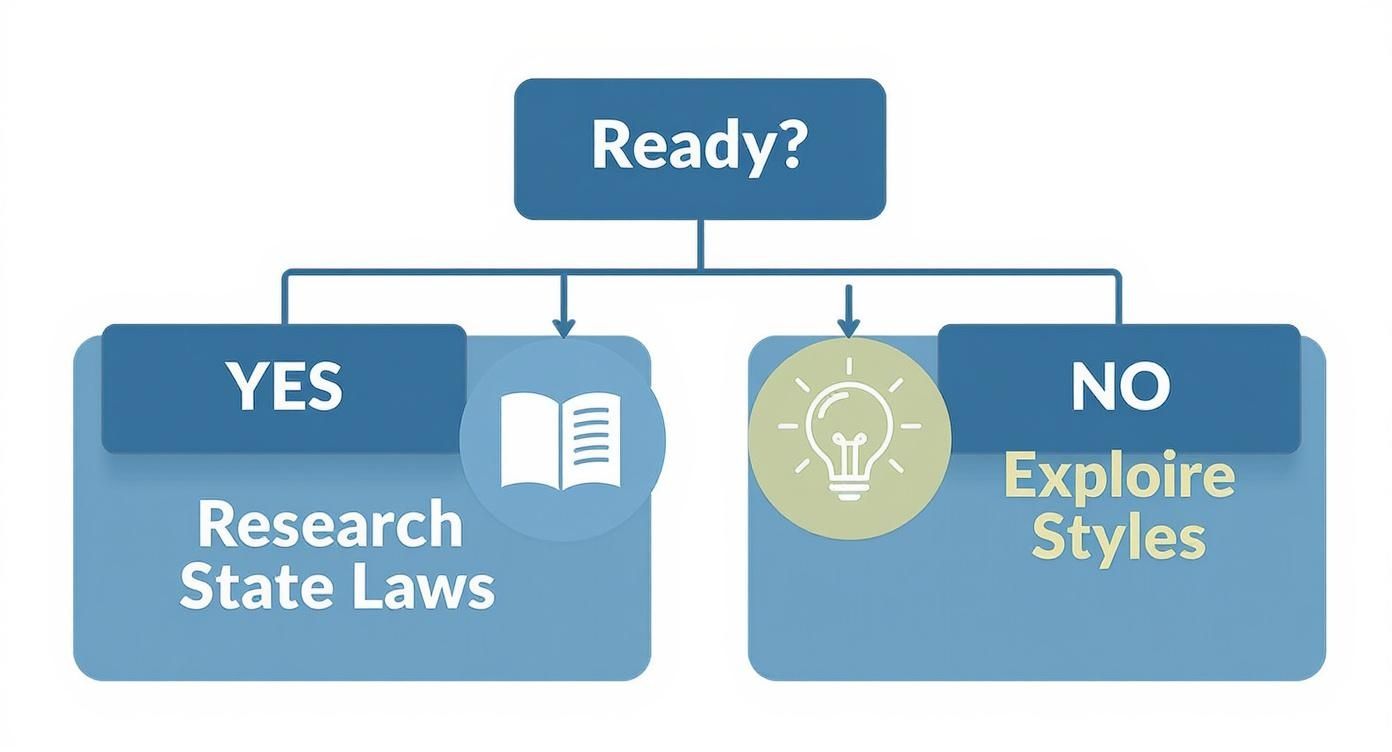
The key takeaway is this: once you've decided to move forward, digging into the legal side is the essential first move. It will shape every decision you make about curriculum and teaching style down the road.
Finding Your State's Official Requirements
Your first stop should always be your state's Department of Education website. This is where you'll find the most accurate and up-to-date information, straight from the source. When searching, use specific phrases like "[Your State] homeschool laws" or "[Your State] Department of Education homeschooling."
As you read through the official rules, you’ll probably run into some common legal terms. Getting a handle on these will make the whole process much clearer.
- Notice of Intent: This is a formal letter you might need to send to your local school district, letting them know you plan to homeschool. Not every state requires one, but for those that do, there are often strict deadlines.
- Required Subjects: Many states have a list of subjects you must teach, like math, language arts, and history. The specifics can vary quite a bit from one state to another.
- Instructional Hours: Some states mandate a minimum number of instruction days (often around 180 days) or a certain number of hours per year.
- Assessment and Testing: High-regulation states might require you to do annual standardized testing or have a portfolio of your child's work reviewed by a certified teacher.
Knowing these terms helps you cut through the legal jargon. Your goal isn't to become a lawyer—it's to confidently understand what's required of your family so you can get back to the joy of learning.
Low-Regulation vs. High-Regulation States
Living in a low-regulation state gives you an incredible amount of freedom. You often don’t have to report your curriculum choices or your child's progress to anyone. That freedom, however, comes with a big responsibility: holding yourself accountable for providing a quality education.
On the flip side, high-regulation states provide a clear framework you have to follow. While it definitely means more paperwork, that structure can be a comfort for parents who are just starting out and want to make sure they're covering all their bases.
These state requirements can even influence which homeschooling styles are most practical for your family. For instance, you can learn more about how state laws impact educational choices by exploring if unschooling is an option in Michigan, a state with more moderate regulations.
No matter where you live, one of the most valuable things you can do is connect with a local homeschool group. Seriously. These are the parents who have already navigated the exact requirements you’re looking at. They can offer practical tips and real-world advice you'll never find on a government website, like how to handle a portfolio review or the best way to submit your paperwork. This local knowledge is one of the most powerful tools you have for starting your homeschool journey on the right foot.
Finding the Right Homeschool Method and Curriculum
Once you've sorted out the legal side of things, you get to the fun part: deciding how you actually want to homeschool. This is where your family’s personality, your values, and your child’s learning style get to shine. It’s about so much more than just picking out textbooks; it's about choosing an educational philosophy that will shape your days.
Think of homeschool methods as different lenses for viewing education. Each one offers a unique approach, and finding the right fit can be the difference between a year of frustration and a year of joyful discovery.
Exploring Popular Homeschool Philosophies
There's a whole world of educational philosophies out there, but don't get overwhelmed. Most new homeschoolers find their footing by exploring a few of the most common ones. Getting a feel for these foundational approaches will help you figure out what resonates most with your vision.
- Traditional (School-at-Home): This is exactly what it sounds like—it mirrors a conventional school. You'll likely use a comprehensive "boxed" curriculum with textbooks, workbooks, and a set schedule for each subject. Many families transitioning from public school start here because the structure feels so familiar.
- Classical Education: Rooted in ancient traditions, this rigorous, language-focused method is built around three learning stages called the Trivium. The Grammar Stage (elementary) is all about memorizing facts, the Logic Stage (middle school) hones reasoning skills, and the Rhetoric Stage (high school) focuses on eloquent expression.
- Charlotte Mason: This is a gentle, literature-rich approach built on the idea that children are whole persons who learn best from "living books" (beautifully written narrative books), nature study, art, and music. It emphasizes short lessons, building good habits, and fostering a deep appreciation for the world.
- Unschooling: Also known as interest-led learning, this is the least structured method of all. It operates on the principle that children are naturally curious and will learn what they need to when they are ready. Learning happens organically through everyday life, play, and diving deep into personal interests.
- Eclectic Homeschooling: Honestly, this is probably the most popular approach. Eclectic homeschoolers don't stick to just one philosophy. Instead, they mix and match methods, curriculum, and resources to build a completely customized education that fits their kids and their own teaching style perfectly.
Key Takeaway: You do not have to pick one method and be married to it forever. So many families (mine included!) find their style evolves as they discover what truly works. The goal is to find a framework that serves your family, not the other way around.
From Philosophy to Practical Curriculum Choices
Once you have a general idea of the how, it’s time to choose the what. Stepping into the world of curriculum can feel like walking into a massive library—the options are endless and a little intimidating. But you can make it manageable by breaking it down.
Your first big decision is whether to go with an all-in-one "boxed" curriculum or piece together your own plan.
- All-in-One Boxed Sets: These kits give you a full year's worth of materials for every single subject, usually from one publisher. They are incredibly convenient, especially for beginners, because all the lesson planning is done for you.
- Eclectic or "Build-Your-Own": This means you're the curriculum designer, choosing individual resources for each subject from different companies. It allows for total customization but definitely requires more upfront research and planning.
To sort through the mountain of options, veteran homeschoolers often turn to trusted review sites. The screenshot below is from Cathy Duffy Reviews, a resource that has been a staple in the homeschool community for years.
Resources like this are gold because they help you filter by subject, grade level, and even educational philosophy to narrow down the choices to something that feels much less overwhelming.
Matching Curriculum to Your Child and Yourself
Here’s the most important piece of advice I can give you: the best curriculum is the one that fits. The most popular, 5-star program will be a complete flop if it doesn’t mesh with your child's learning style and your own personality as a teacher. Before you click "buy," take some time to just observe your family.
Ask yourself these questions:
- How does my child really learn? Is he a hands-on kid who needs to move? Is she a visual learner who loves charts and videos? Or maybe an auditory learner who remembers everything you read aloud?
- What's my teaching style? Do I need the security of a detailed, open-and-go lesson plan, or do I prefer a more flexible, spontaneous approach? Am I excited to teach a subject, or would I rather have a program with video lessons to do the heavy lifting?
- What is our family's real-life rhythm? A curriculum that requires hours of prep time simply won't work for a busy parent juggling multiple responsibilities. Be realistic about your time and energy.
Knowing the answers to these questions will be your best filter. For a deeper dive into specific programs that work well for new families, our guide on the best homeschool curriculum for beginners offers some great starting points.
Finding the right curriculum is a process of discovery. Give yourself the grace to experiment—it’s one of the best gifts you can give your new homeschool.
Creating a Homeschool Schedule That Actually Works
Let's talk about one of the biggest pitfalls for new homeschoolers: trying to cram a rigid, 8-to-3 public school day into your living room. I see it all the time, and it almost always leads to frustration and burnout for everyone involved. The real magic of homeschooling isn't recreating school at home—it's crafting a rhythm that genuinely fits your unique family.
Your goal isn't a minute-by-minute itinerary. It's a flexible routine that provides just enough structure to keep you moving forward without stamping out all the fun. You need to let go of that school bell mindset and embrace a flow that leaves room for spontaneous deep dives, unexpected field trips, and yes, even sick days or doctor's appointments without derailing the entire week.
https://www.youtube.com/embed/G7Vdl-R2e5Q
Ditch the Clock and Find Your Flow
Forget the hour-by-hour planner for a minute. Many seasoned homeschool families, myself included, thrive on more fluid methods that prioritize consistency over rigidity. These approaches help you cover all your bases without the constant pressure of a ticking clock.
Two of the most effective and popular methods you'll hear about are block scheduling and loop scheduling.
- Block Scheduling: Instead of trying to touch on seven different subjects every single day (exhausting!), you focus on just one or two subjects for a longer, more immersive chunk of time. You might dedicate Mondays and Wednesdays to a deep dive into history and science, while Tuesdays and Thursdays are reserved for math and language arts.
- Loop Scheduling: This is a game-changer for subjects that don't need daily attention, like art, music, composer study, or foreign languages. You just create a list of these subjects and work your way through it. When it's time for a "loop" subject, you do the next one on the list. The next time, you pick up where you left off.
A loop schedule is an absolute lifesaver. If life gets messy and you have to skip a day, you don't fall "behind." You just pick up with the next subject on your loop the next time you get to it. No guilt, no frantic catch-up—just steady, forward progress.
This simple trick ensures all those important "extra" subjects get consistent attention over the weeks and months, even when your daily schedule is anything but predictable.
What This Looks Like in a Real Family
The real art is blending these methods to manage kids of different ages and stages. A successful homeschool schedule isn't about everyone doing the same thing at the same time; it's about orchestrating a harmony of independent work and group activities.
Here’s a practical example of how a family with an 11-year-old and a 7-year-old might structure their day:
| Time Block | 11-Year-Old (Independent) | 7-Year-Old (Guided) | Together |
|---|---|---|---|
| Morning (9-10 AM) | Math curriculum on the computer | One-on-one reading lesson with Mom | |
| Mid-Morning (10-11:30 AM) | Independent writing assignment | Educational games and hands-on math | |
| Group Block (11:30-12:30 PM) | Read-aloud history chapter and discussion | ||
| Afternoon (1:30-2:30 PM) | Reading for literature | Independent play / quiet time | Loop Subject: Nature journaling in the backyard |
See the flow? The morning is dedicated to core subjects where each child needs individual focus, allowing you to toggle between them. Then, a "group block" brings everyone together for shared learning in subjects like history, science, or Bible study, which are often easy to adapt for multiple ages.
Planning Lessons Without the Overwhelm
So, how do you turn this beautiful schedule into actual daily lessons? The key is to plan in manageable chunks. Don't try to map out an entire year in excruciating detail—you'll drive yourself crazy.
Instead, focus on planning just one week at a time.
This gives you a clear roadmap for the immediate future but preserves the flexibility to adapt. On Sunday evening, take 30 minutes to sit down and sketch out the week ahead:
- Review the last week: What worked? What felt rushed or chaotic? Adjust accordingly.
- Pencil in the "big rocks": Note any appointments, co-op days, or library trips first.
- Assign main lessons: Decide on the primary topics for your core subjects (e.g., "fractions in math," "the American Revolution in history").
- Check your loop: See what's next on your loop schedule and plug it into a couple of open slots.
This simple weekly rhythm provides just enough structure to keep you on track while giving you the freedom to chase rabbit trails and seize learning opportunities as they arise. It’s the perfect balance for a homeschool schedule that truly serves your family, not the other way around.
How to Budget for Homeschooling Without Breaking the Bank
One of the biggest myths I hear about homeschooling is that it’s just too expensive for the average family. But after years in this community, I can tell you that’s simply not true. When you homeschool, you’re not just taking on educational costs—you’re gaining total control over where every single dollar goes. With a bit of smart planning, you can give your kids a rich, engaging education on a budget that actually works for your family.
The financial upside is bigger than most people realize. For taxpayers, homeschooling saved an estimated $51 billion during the 2021-22 school year alone. For families, the savings are more personal. Many of us spend far less than we would on private school, which can easily run over $12,000 a year. If you want to dive into the numbers, the National Home Education Research Institute has some great facts. This cost-effectiveness is a huge reason so many families can make homeschooling a long-term reality.
Identifying Your Core Homeschool Expenses
Before you can start saving, you need a clear picture of where your money is actually going. Most homeschool expenses fall into just a few main categories. Thinking through these ahead of time helps you build a realistic budget from day one and avoid those surprise costs later on.
Your main spending areas will likely be:
- Curriculum and Books: This is often the biggest line item. It can range from completely free online programs to comprehensive, all-in-one boxed sets that cost hundreds of dollars.
- Supplies: Think beyond just crayons and notebooks. This bucket includes everything from science experiment kits and math manipulatives to printer ink and art supplies.
- Co-ops and Classes: If you join a local co-op or sign your kids up for specialized classes like art, music, or a foreign language, those fees will be a recurring expense.
- Field Trips and Extracurriculars: Don't forget to budget for museum admissions, sports team fees, and other real-world learning adventures.
- Technology: This could be a subscription to an educational app, a dedicated laptop for your child, or just your high-speed internet bill.
The real beauty of a homeschool budget is its flexibility. A month where you splurge on a new curriculum can be balanced by a low-cost month focused on library books and local nature walks. You are in the driver's seat.
Smart Strategies for Saving Money
Being a savvy homeschool shopper doesn’t mean you have to sacrifice quality. It’s all about knowing where to find incredible value—and a lot of it is free. With a few smart habits, you can stretch every dollar and still provide an amazing education for your kids.
Honestly, being resourceful quickly becomes a fun challenge. You start to see how much you can accomplish for less.
Top Money-Saving Tips for Homeschoolers
| Strategy | How It Works | Pro Tip |
|---|---|---|
| Leverage Your Library | Your local library is your absolute best friend. It offers so much more than books—think free access to educational databases, documentaries, audiobooks, and even museum passes. | Get to know your children's librarian! They are resource ninjas and can point you toward amazing programs and materials you'd never find on your own. |
| Buy Used Curriculum | Never, ever buy new when you can get a gently used version for a fraction of the price. The content is exactly the same, I promise. | Check out Facebook Marketplace, homeschool buy/sell/trade groups, and websites dedicated to used curriculum. The best deals pop up in late spring as families clear out their old materials. |
| Utilize Free Online Resources | The internet is overflowing with high-quality, free educational content. You can find full curriculums, printable worksheets, and fantastic video lessons without spending a dime. | I keep a dedicated folder in my browser's bookmarks just for free resources. Whenever I stumble upon a great new site, I add it to the collection. |
| Ask for Educator Discounts | So many stores—from craft suppliers like Michaels to bookstores like Barnes & Noble—offer discounts to homeschoolers. | Always, always ask at checkout if an educator discount is available. You’ll be surprised how often the answer is yes. It only takes a second to ask. |
By building a thoughtful budget and actively looking for savings, you'll find that homeschooling is not just an educationally sound choice, but a financially smart one, too.
Building a Thriving Social Life for Your Child

Let's just get it out of the way. It's the number one question every homeschooling parent gets asked, usually with a concerned tone: “But what about socialization?” It’s such a common question, it’s practically a rite of passage for new homeschoolers.
The good news? The old stereotype of the lonely, isolated homeschooler is a complete myth.
In my experience, homeschooling actually offers a far more natural and powerful way for kids to develop social skills. Instead of being confined to a classroom with 25 other kids their exact age, they get to interact with people of all ages and backgrounds in real-world settings. This builds confidence, empathy, and communication skills in a way a traditional school environment often can't.
Creating Your Community
The secret is being intentional about creating opportunities for your kids to connect with others. The goal isn't to replicate a crowded school playground but to build a vibrant, supportive community around your family. Luckily, the homeschool world is bursting with ways to do just that.
You can start by looking for local groups that click with your family’s interests and values. These communities are the lifeblood of the homeschool experience for so many of us, providing both academic fun and lasting friendships for you and your children.
- Homeschool Co-ops: These parent-led groups are a cornerstone for countless families. Parents often pool their talents to teach subjects like art, messy science labs, or foreign languages in a fun group setting.
- Sports Leagues and Teams: Many areas have dedicated homeschool sports leagues for everything from soccer to basketball. It’s a fantastic outlet for physical activity and learning about teamwork.
- Local Library Programs: Don't forget your local library! They frequently host book clubs, STEM workshops, and other events specifically for homeschoolers. Ours has been an amazing resource.
- Volunteering: Working together at an animal shelter or a community garden teaches incredible lessons in compassion and responsibility while connecting your child with others who share their passions.
Homeschool socialization is about quality over quantity. It’s about fostering deep, meaningful connections in diverse settings, not just navigating crowded hallways. Your child learns to talk to adults, play with younger kids, and collaborate with peers in authentic, real-life ways.
Finding and Joining Local Groups
Finding these opportunities is probably easier than you think. A great first step is a simple Facebook search for "[Your Town] Homeschool Group." You'll likely find several active communities where parents share resources, plan park days, and organize field trips.
Another fantastic option is the homeschool co-op. These groups offer a wonderful blend of structured learning and social time. If you’re not sure how they work, you can find a great explanation of what a homeschool co-op is to see if it’s the right fit for your family. Creating chances for interaction is key; you might want to explore some top group activities for children to boost wellbeing to foster friendships outside of academics.
If you can't find a group that feels like a perfect match, don't be afraid to start your own! A simple nature club, a weekly park meetup, or a book club can be a powerful way to build the exact community you're looking for. By proactively building these connections, you're not just answering the socialization question—you're giving your child a rich, varied, and thriving social life.
Common Questions About Starting to Homeschool
Stepping into the world of homeschooling can feel like learning a new language, with its own culture and unspoken rules. It's totally normal to have a long list of questions swirling around in your head. Let's tackle some of the most common ones to give you some clarity and confidence.
One of the very first questions I hear is almost always, "Am I actually qualified to teach my own child?" The answer is a resounding yes. You know your child better than anyone else on the planet. Your love, dedication, and ability to find great resources are far more important than a teaching degree.
Another frequent worry is about educational gaps. "What if I miss something important?" Take a deep breath. No education is completely gap-free—not even in the best traditional schools. The real beauty of homeschooling is the power to customize learning to your child's pace and interests, which is how you foster a genuine love for learning that will stick with them for life.
How Much Time Does It Take Every Day?
This is a big one, especially for parents who are also juggling work or other responsibilities. The good news? You can forget the 6-hour school day model. One-on-one instruction is incredibly efficient.
- Early Elementary (K-2): Often requires just 1-2 hours of focused, structured instruction each day.
- Upper Elementary (3-5): Typically bumps up to around 2-3 hours of more structured learning.
- Middle & High School: Can range from 3-5 hours, with students taking on much more independent work.
The rest of the day isn't wasted time—it’s filled with organic learning through play, reading, chores, and real-world experiences. Your entire day becomes the classroom, not just the time you spend with textbooks at the kitchen table.
Finally, there’s the big assessment question: "How do I know if my child is on track?" While some states do require standardized tests, your daily interaction is the single best assessment tool you have. You will see firsthand where your child excels and exactly where they need a little more support. This immediate feedback loop is one of homeschooling's greatest strengths.
At The Mom Resource, we believe in equipping you with the tools and encouragement you need for your family's unique educational journey. Find more practical guidance and community support here: https://themomresource.com.